
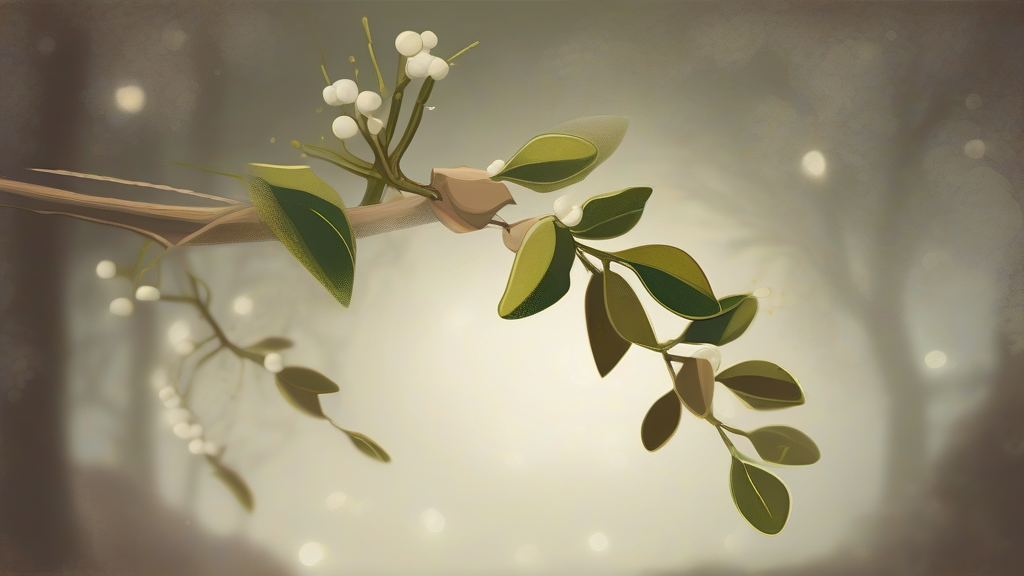
What does mistletoe mean?
Mistletoe is an evergreen plant that grows on the branches of trees, including apples, oaks, and other deciduous trees. It is a hemiparasite: its roots penetrate the host tree and draw water and nutrients from it, although it can still photosynthesize and produce leaves of its own. The plant is especially associated with Christmas, when sprigs are displayed indoors and, in a longstanding British tradition, couples may kiss beneath them. Its white berries are also a distinctive feature, though the plant is not generally considered a food source. The word combines an old element meaning “mistletoe” with an Old English word for “tree,” reflecting the plant’s unusual habit of growing high in other trees rather than in the soil. Mistletoe is a familiar seasonal symbol with a slightly paradoxical character: a cheerful decorative plant that lives by taking resources from its host.
An evergreen hemiparasitic plant that grows on the branches of trees and bears white berries.
"Mistletoe was visible in the crown of the old apple tree."
The term can refer to the plant itself, a sprig of it, or decorative material made from it.
A sprig or piece of mistletoe used as Christmas decoration, particularly in traditions involving kissing beneath it.
"They hung mistletoe in the hall before the party began."
This sense is especially associated with Christmas customs in Britain and other English-speaking countries.
The plural is used when referring to multiple plants, sprigs, or decorative pieces.
"The florist displayed several mistletoes in glass bowls."
Mistletoe is a paradoxical Christmas plant: it looks leafy and delicate while actually draining life from the tree it grows on.
Reviewed by Deb Chak, Editor. AI-assisted content curated by RJS Tech Solutions LLP.
Etymology of mistletoe
The English word comes from Old English misteltēow, a compound formed from mistel- meaning “mistletoe” and tēow meaning “tree.” The element mistel- has relatives in several Germanic languages, including German Mistel and Dutch mistel, while the tree element reflects the plant’s characteristic growth on the branches of other trees. The form evolved through Middle English and later variant spellings before settling on the modern word mistletoe.
How mistletoe is actually used
In British English, the traditional custom of kissing beneath mistletoe is especially associated with Christmas gatherings. In general use, the word can refer either to the living plant or to cut decorative material taken from it.