
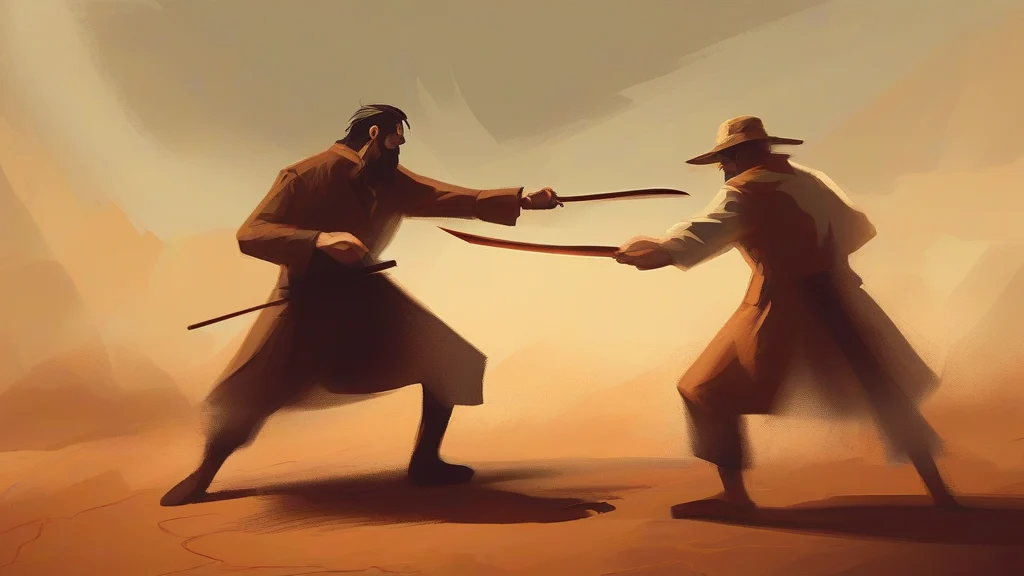
What does monomachy mean?
Monomachy denotes combat conducted between two individual opponents, most often in the form of a formal duel. Its modern use is uncommon and generally literary or historical, particularly in accounts of medieval warfare, personal disputes, and challenges intended to settle a matter without a larger battle. The word can suggest an intensely personal confrontation in which a broader conflict is concentrated on a single pair of combatants. A monomachy may also be arranged by agreement, as was common in stories of kings resolving disputes through champions, although the term does not necessarily imply that arrangement. Compared with the more familiar word duel, monomachy is broader in historical usage and sounds formal or archaic. It is therefore best suited to narration in a literary or historical register rather than ordinary contemporary description.
nounA fight or combat between two individual opponents, especially an arranged duel. The word is chiefly literary and historical.
- A combat between two individual opponents, especially a formal or arranged duel.
"The rival sovereigns agreed to settle their dispute through a monomachy rather than a full-scale war."
"Each champion entered the field prepared for a monomachy that would decide the fate of the disputed territory."
"Accounts of the conflict describe the opening monomachy before the engagement developed into a larger battle."
The regular plural of the noun; the singular form ends in -y, which changes to -ies in the plural.
"The chronicles recount several monomachies between rival knights."
Monomachy puts one against one in a battle reduced to its most personal form: a duel.
Reviewed by Deb Chak, Editor. AI-assisted content curated by RJS Tech Solutions LLP.
Where does monomachy come from?
Monomachy comes from the Greek monomakhía, a compound formed from monos, meaning “single” or “one,” and makhē, meaning “battle.” The term passed into English through Latin and French usage during the early modern period. Its Greek components also underlie numerous English words beginning with mono-, although forms such as monarch, monopoly, monolith, and monogram combine monos with different roots.
Related word forms
How monomachy is actually used
Rare and literary. It is chiefly used in historical narratives, formal prose, and accounts of combat between individuals.