
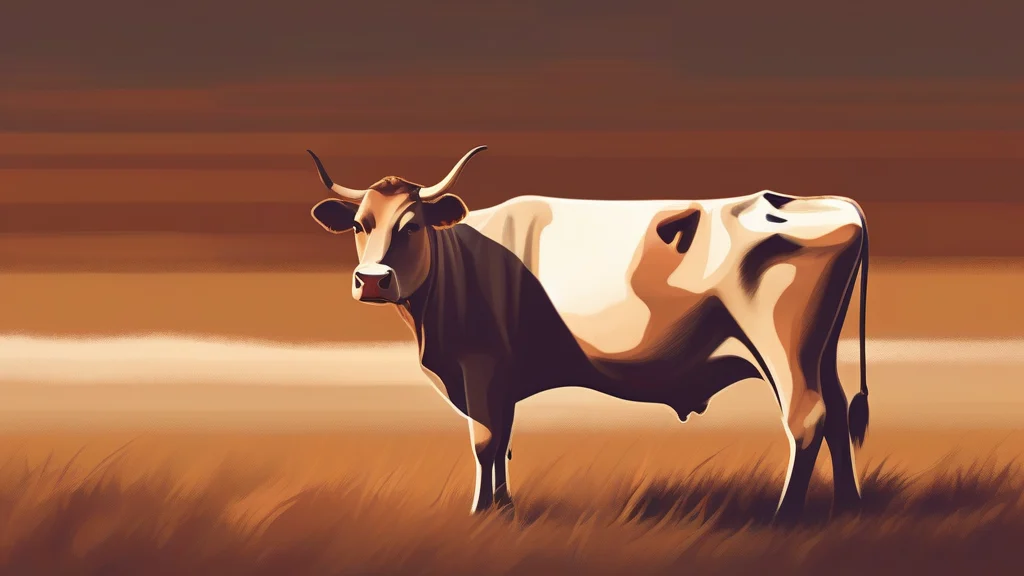
What does mooed mean?
Mooed is the past tense and past participle of moo, the verb for making the low, drawn-out sound associated with cattle. It is most often heard in farm, countryside, or children’s stories: a cow mooed, a herd mooed at dawn, or an impatient animal mooed for food. The word can also be used as an adjective for fabric or clothing marked with irregular patches resembling a cow’s hide, though this use is much less common and chiefly descriptive. As a verb, mooed is standard informal English and often appears in reported speech, writing, and direct quotation. As an adjective, it functions mainly in clothing descriptions and evokes the distinctive patchwork appearance of cowhide. The form therefore carries two related but clearly distinguishable meanings, one concerning the sound made by cattle and the other concerning a cow-like visual pattern.
To make the low, prolonged sound characteristic of a cow.
"The cattle mooed when the farmer approached with their feed."
Mooed is the past tense and past participle of moo.
Marked with irregular spots or patches resembling a cow's hide.
"The jacket had a striking mooed pattern in black and white."
This use is uncommon and is chiefly found in descriptions of clothing and fabric.
From the farmyard to the fashion world: a “mooed” fabric is one covered with cow-like patches.
Reviewed by Deb Chak, Editor. AI-assisted content curated by RJS Tech Solutions LLP.
Where does mooed come from?
Mooed is formed from the verb moo with the regular English past-tense and past-participle ending -ed. The verb moo is an imitative word whose sound imitates the low call of cattle; its precise historical development is uncertain. The adjective mooed is also associated with moo, but in the sense of cow-like spots or patches rather than the animal’s call.
Related word forms
How mooed is actually used
As a verb, mooed is the usual past tense and past participle of moo. The adjective sense is uncommon and occurs chiefly in descriptions of clothing or fabric patterned with cow-like spots.