
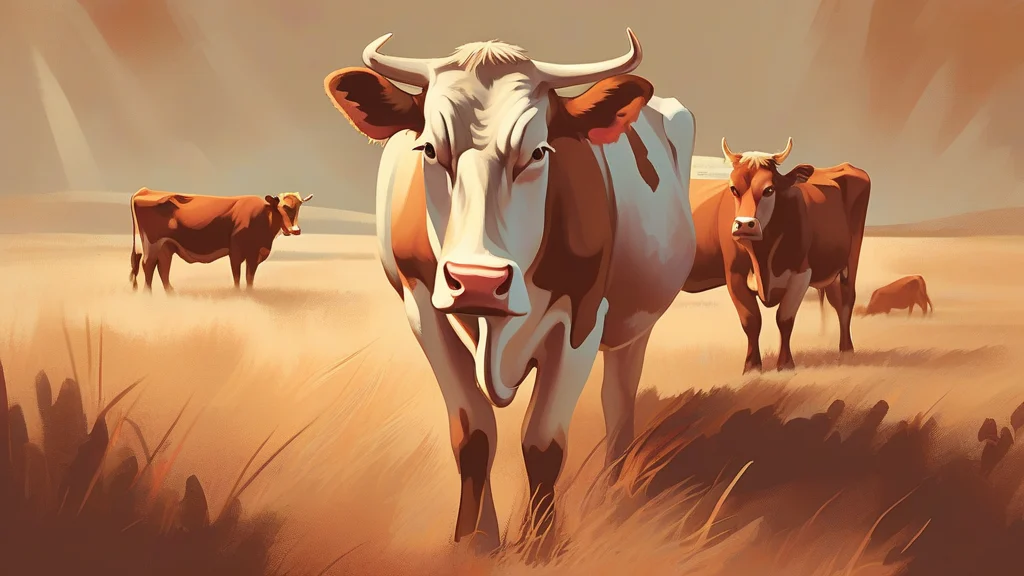
What does mooing mean?
Mooing is the present participle of moo, meaning to make the low, prolonged, resonant call associated with cattle. It is especially common in pastoral and rural contexts, such as descriptions of cows in fields, livestock yards, or farmyards. The word may also be used more broadly for a similar low sound, although its usual reference is to cattle. As an attributive form, “mooing” commonly appears before nouns: “mooing cows,” “a mooing herd,” or “the mooing sound.” The expression is generally neutral rather than derogatory. Its appeal lies in being a clear instance of sound imitation: both the pronunciation and the spelling evoke the sustained, low call of a cow. It is therefore especially vivid in writing intended to evoke farms, countryside scenes, or the calls of cattle.
verbThe present participle of moo: making a low, prolonged sound characteristic of cattle.
- Making a low, prolonged, resonant sound characteristic of cattle.
"The cows stood in the field, mooing softly as the evening approached."
"We heard the cows mooing impatiently near the gate."
"A herd of cattle was mooing in the misty field."
Mooing is sound imitation: its simple spelling and sound closely mimic the low, drawn-out call of cattle.
Reviewed by Deb Chak, Editor. AI-assisted content curated by RJS Tech Solutions LLP.
Where does mooing come from?
Mooing is derived from the English verb moo, an imitative word for the low call of cattle. The verb is attested from the early modern period, and mooing has since developed as its standard present-participle form.
Related word forms
How mooing is actually used
The term is neutral and commonly used for the characteristic call of cows, though it may also describe any similarly low, resonant animal sound. As a participle, it can function attributively, as in “mooing cows.”
Easily confused with mooing
Mooing means making a low animal call, whereas mowing means cutting grass or hay with a mower.