
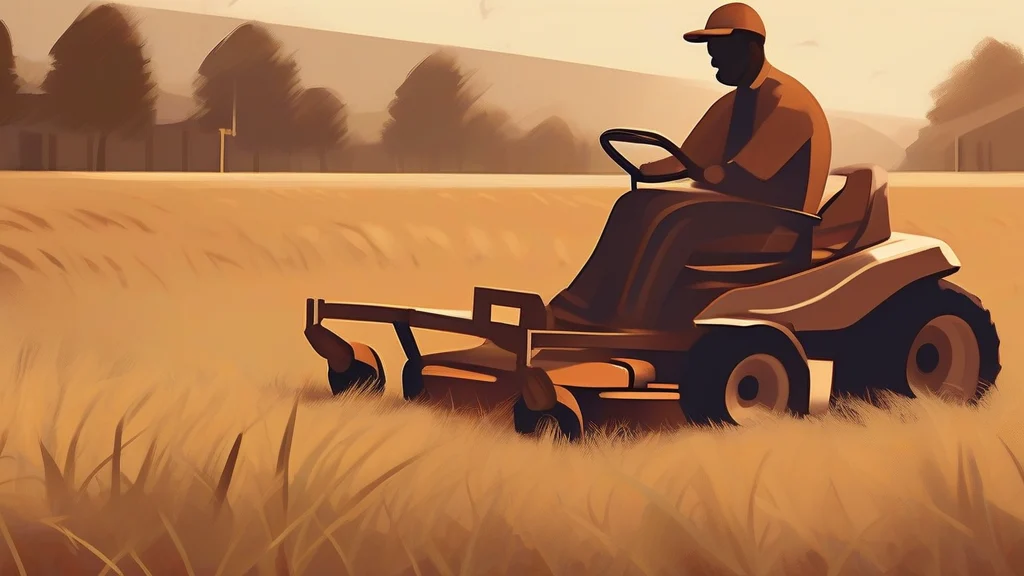
What does mowing mean?
Mowing is the activity of cutting grass, grain, or another crop, usually with a machine powered by a petrol engine or electricity. In everyday use, it most often appears as the present participle of the verb “mow,” as in “mowing the lawn,” or as a noun naming the work itself. Mowing is distinct from trimming because it generally implies cutting a crop close to the ground over a broad area. The word also has a violent figurative use. In the expression “mow down,” it means to kill people rapidly with gunfire, often suggesting a lack of discrimination. This sense derives from an image of something being cut down and is much more dramatic than the ordinary agricultural meaning. Although “mowing” is grammatically the present participle of “mow,” it is commonly treated as an independent lexical item when discussing mowing equipment, seasonal work, or the figurative expression “mowing down.”
Engaged in cutting grass, grain, or another crop with a mower or similar implement.
"The farmer is mowing the grass along the field boundary."
This is the present participle of “mow” and may function adjectivally, as in “a mowing machine,” or as part of a progressive verb form.
The act or work of cutting grass, grain, or another crop.
"Mowing the meadow is easiest when the grass is dry."
Usually uncountable in the agricultural sense.
Killing people rapidly with gunfire, especially without regard for individual targets.
"The gunmen continued mowing down the soldiers near the entrance."
This figurative sense usually occurs as “mow down” or “mowing … down” and is markedly more violent and dramatic than the agricultural sense.
Mowing is normally an uncountable noun naming an activity; “mowings” is not standard in ordinary usage.
"The mowing of the field was delayed by heavy rain."
Mowing began as a way of cutting a crop; “mowing down” later borrowed the image to describe rapid, indiscriminate gunfire.
Reviewed by Deb Chak, Editor. AI-assisted content curated by RJS Tech Solutions LLP.
Where does mowing come from?
The word descends from Middle English “mowe,” which developed from Old English “māwan,” meaning “to cut grass or grain.” The verb ultimately belongs to the Germanic family and has relatives in languages such as Dutch and German. The modern form “mowing” was formed by adding the present-participle suffix “-ing” to the base verb.
Related word forms
How mowing is actually used
The agricultural sense is routine in both British and American English. The figurative sense is more dramatic and potentially sensational, and it normally appears in the construction “mow down” or as “mowing” followed by “down.”
Easily confused with mowing
Mowing means cutting grass or crops, whereas moving means changing position or transporting something.