
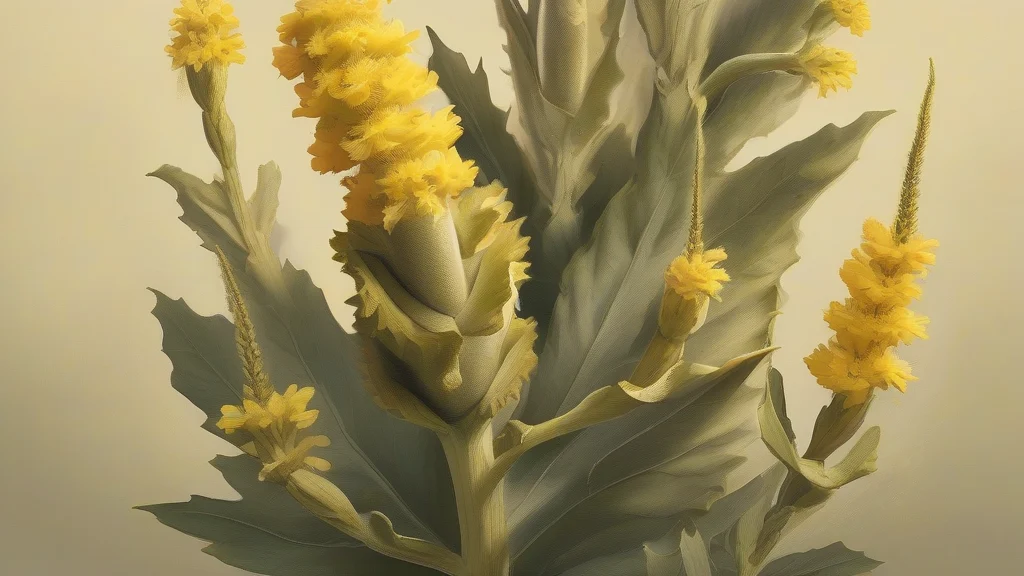
What does mullein mean?
Mullein is an English name for plants in the genus Verbascum, particularly Verbascum thapsus, the common or great mullein. This biennial plant is easily recognized by its large, velvety leaves and tall upright spikes of yellow flowers, and it frequently grows along roadsides, in fields, and on disturbed ground. Its foliage has long been valued for its soft texture, which also explains the word’s name: it ultimately derives from a Latin term meaning “soft.” Mullein leaves and flowers have also been used in teas, syrups, and traditional herbal preparations, although such uses should not be confused with proof of medical effectiveness. The word appears in both British and American English, while names such as flannel leaf and flannel plant reflect the leaves’ soft, cloth-like surface. Mullein is especially useful to readers because it brings together a familiar wildflower, a distinctive historical name, and a long-standing herbal use.
nounAny of various plants in the genus Verbascum, especially the common or great mullein, Verbascum thapsus, a biennial with broad, woolly leaves and tall spikes of yellow flowers. The word may also refer to the leaves or flowers of these plants as used in teas and traditional herbal preparations.
- Any of various herbaceous plants in the genus Verbascum, especially Verbascum thapsus, characterized by woolly foliage and yellow flowers.
- The leaves or flowers of a mullein plant when prepared or used as an herbal material.
"Tall spikes of golden mullein rose above the dry grass along the roadside."
"The herbalist steeped dried mullein leaves to make a soothing infusion."
"A mature mullein can produce a striking vertical spike of small yellow blossoms."
The plural is used when referring to multiple plants or distinct specimens of the plant.
"Several tall mulleins grew among the thistles at the edge of the field."
Mullein takes its name from the unusually soft, woolly leaves that once made its name mean “soft” in Latin.
Reviewed by Deb Chak, Editor. AI-assisted content curated by RJS Tech Solutions LLP.
Etymology of mullein
The word entered Middle English through Anglo-French moleine and Medieval Latin molleina. Its further root is Latin molle, the neuter form of mollis, meaning “soft,” a reference to the plant’s woolly leaves. The same Latin root underlies cognates such as mollify, mollification, and mollusk.
Related word forms
How mullein is actually used
In contemporary English, “mullein” most often refers to the common mullein or, more broadly, plants in the genus Verbascum. In herbal contexts it can denote the dried leaves or flowers rather than the whole growing plant. The term is not restricted to a single English-speaking region.