
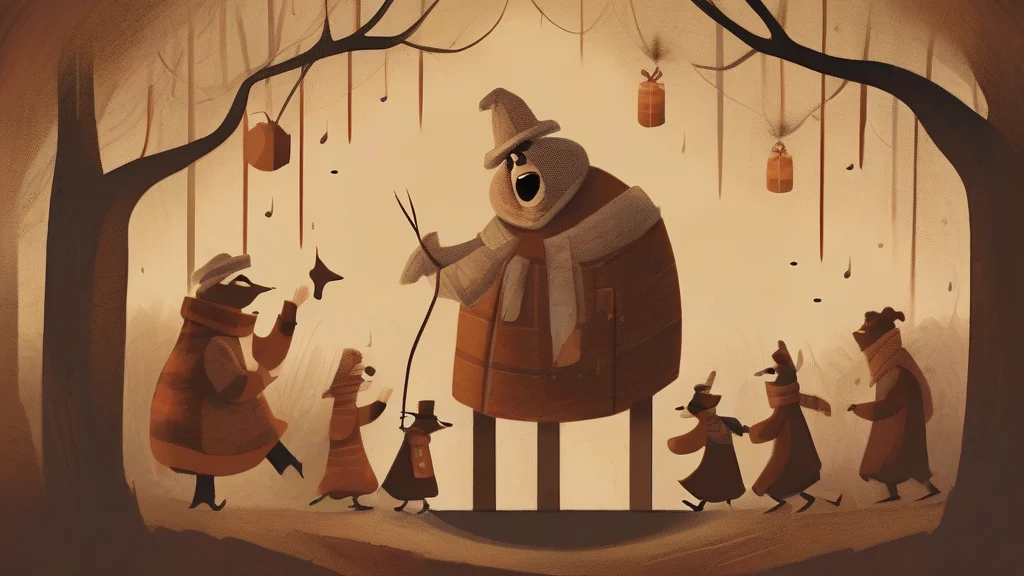
What does mumming mean?
Mumming most commonly describes speech that is low, indistinct, or difficult to understand, as when someone murmurs under their breath or repeats words unclearly. In this use, it is the present participle of mumm and often carries a mildly informal or mildly negative implication: the speaker may be quiet, confused, or simply not making the words clear. Mumming also has a more unusual and festive noun meaning. It refers to a traditional form of Christmas house-to-collecting entertainment in which groups of performers visit neighboring homes, sing, act, or offer humorous performances in return for food or hospitality. The word therefore joins ordinary, everyday speech with a vivid piece of seasonal social history. Its regional associations are strongest in Britain and Ireland, although related mumming customs have been documented in other English-speaking communities, including Newfoundland. The two senses make mumming especially useful for discussions of language, oral performance, and folklore traditions.
Speaking in a low or indistinct voice, so that the words are difficult to hear or understand.
"She kept mumming the lyrics while the music played."
Usually informal and often mildly dismissive or amused; the full verb is mumm.
The traditional practice of visiting houses at Christmas, often in groups, to sing, act, or entertain the occupants.
"Mumming was part of the village's Christmas festivities every year."
Chiefly associated with traditional British and Irish Christmas customs and usually used in the singular, without a regular plural.
The noun is normally used in the singular and does not have a standard plural form.
"The children took part in the local mumming on Christmas Eve."
Mumming has a festive second life: it names both indistinct speech and a Christmas tradition of house-to-house performers who sing, joke, and entertain.
Reviewed by Deb Chak, Editor. AI-assisted content curated by RJS Tech Solutions LLP.
Etymology of mumming
The verbal form is derived from mumm, a variant of mumble, and ultimately belongs to a family of words connected with indistinct or concealed speech. The traditional noun developed from the practice of people going about from house to house at Christmas, commonly known as mummers. The precise origin of the older word is historically uncertain, so it is safest to connect the modern senses with the established mum, mumble, and mummer word family rather than assign a definite foreign source.
How mumming is actually used
The verbal use is an inflection of mumm and is often informal or mildly dismissive, implying that someone's speech is quiet, unclear, or difficult to understand. The traditional noun sense is more associated with British and Irish Christmas customs, though related traditions are found elsewhere.
Easily confused with mumming
Mumbling is the usual everyday verb for speaking indistinctly, while mumming can also name the traditional Christmas practice of visiting houses and entertaining people.