
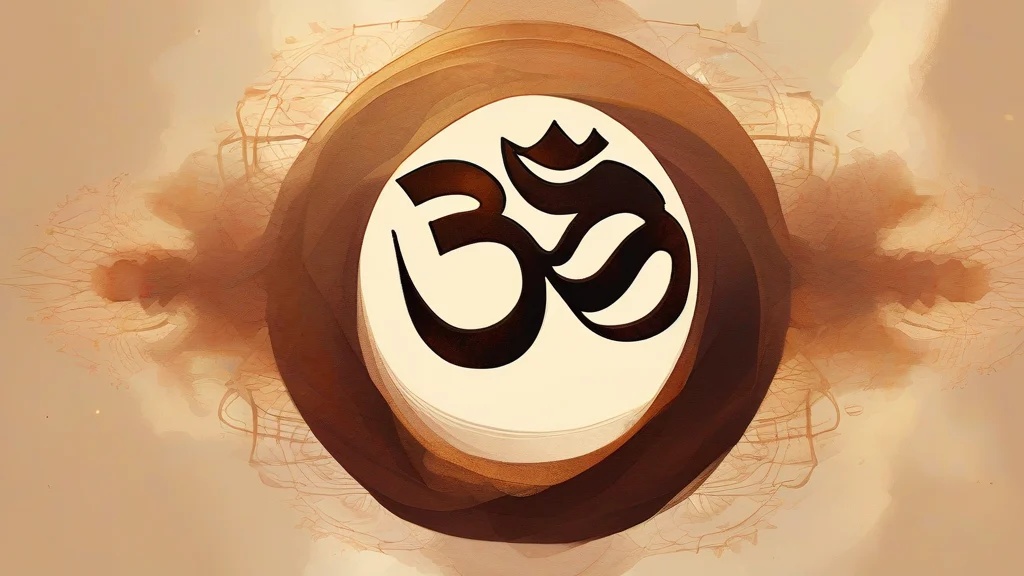
What does om mean?
“Om” is a sacred syllable best known from Hindu, Buddhist, and Jain religious practice, where it may be spoken or chanted during meditation, prayer, the beginning of a mantra, or other forms of worship. Its pronunciation is generally represented as a long “o” followed by “m,” though traditional and transliterated forms vary somewhat by language and school of recitation. In English, “om” can also function as an exclamation expressing affirmation, contemplation, or spiritual awareness. As a noun, it can refer to the syllable itself or, more broadly, to a sacred mantra or chant associated with it. Although short and simple in appearance, “om” carries a complex cultural history and is one of the most recognizable sounds in several Asian religions. Outside explicitly religious contexts, its use often lends a solemn, meditative, or spiritual tone to speech.
A sacred syllable or spiritually expressive utterance used especially in prayer, chanting, meditation, or as an affirmation.
"The worshipper softly uttered om as the room fell quiet."
Used in religious settings across several traditions; in nonreligious English it may sound solemn, contemplative, or unconventional.
The sacred syllable used in Hindu, Buddhist, and Jain prayer and meditation; more broadly, a mantra or chant centered on this sound.
"The monk repeated the om twenty-one times."
The plural “oms” is used when individual utterances or written occurrences are counted.
Used when separate utterances of the sacred syllable are counted.
"The class chanted three oms before the meditation began."
One three-letter sound can serve as a sacred syllable, a focus for meditation, and a concentrated mantra.
Reviewed by Deb Chak, Editor. AI-assisted content curated by RJS Tech Solutions LLP.
Where does om come from?
The word comes from Sanskrit, where it is written “oṃ” and pronounced with a complex vowel sound followed by “m.” It is widely used in Sanskrit-based religious and philosophical traditions, including Hinduism, Buddhism, and Jainism. The precise historical development of its sound and spelling is complex, and modern English generally simplifies it to “om” or uses the variant “aum.”
How om is actually used
In religious contexts, the syllable is commonly written “Om” and may be transliterated as “oṃ”; “aum” is another established spelling. When used as an English exclamation, it can sound formal, contemplative, or deliberately unconventional.
Easily confused with om
“Om” is a sacred syllable or mantra, whereas “ohm” is the international unit of electrical resistance.