
What does orchestration mean?
Orchestration most commonly refers to the art of arranging and blending music for an orchestra. It involves assigning roles to different instruments, combining their timbres, and balancing individual parts so that the ensemble develops a coherent musical texture. The word also has an important figurative use: the orchestration of a campaign, project, or complex event means organizing people, resources, and actions in a carefully coordinated manner. In this sense, orchestration can suggest either skilled artistic planning or calculated control, depending on the context. The figurative meaning has become especially common in politics, business, and media, where several participants contribute to a unified effort. Although the vocabulary is often associated with classical and orchestral music, it is fully natural in modern English when discussing how complex activities are arranged. Its usefulness lies in conveying both musical arrangement and broader strategic coordination without necessarily implying that every participant has an identical role.
nounThe art or process of arranging and coordinating musical parts for an orchestra. By extension, it means the organization, management, or careful coordination of a complex activity or undertaking.
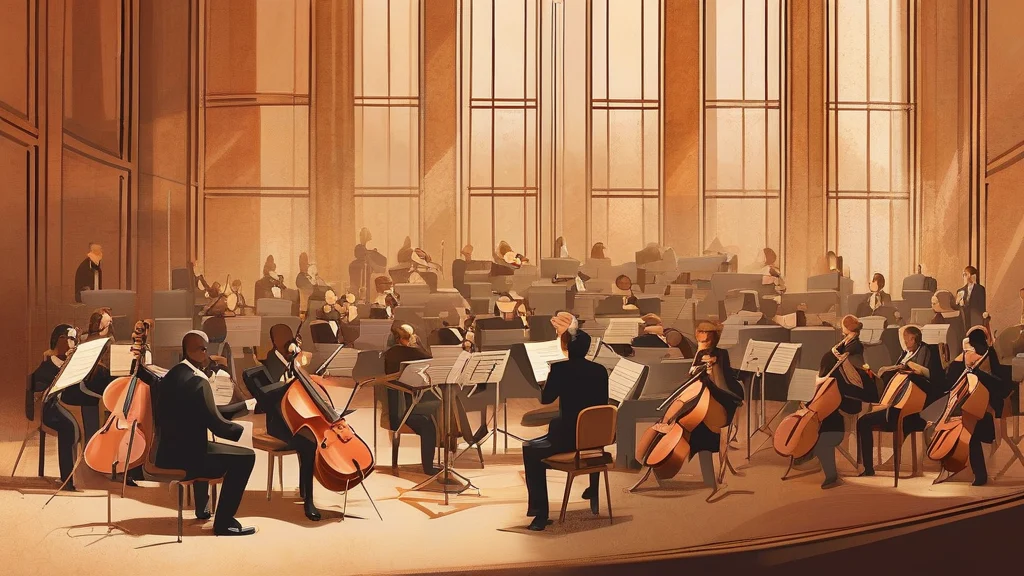
- The art or process of arranging music for an orchestra, including the allocation and blending of instrumental parts.
- The organization, management, or coordinated execution of a complex activity or undertaking.
"The composer's orchestration gives each instrument a distinct role while allowing the ensemble to sound cohesive."
"The recording was praised for its rich orchestration and the balance between the strings and woodwinds."
"The careful orchestration of volunteers, donors, and local officials made the campaign a success."
Used when referring to distinct completed arrangements of music or separate instances of coordinated organization.
"The conductor compared the orchestrations of the two operas before choosing the opening piece."
An orchestra began as a place for dancing in ancient Greek theatre before the word came to mean the musicians themselves.
Reviewed by Deb Chak, Editor. AI-assisted content curated by RJS Tech Solutions LLP.
Where does orchestration come from?
Orchestration ultimately traces to Greek orchēstron, a term associated with an arranged space for dancing and, later, the chorus in ancient Greek theatre. English adopted orchestra for an ensemble of instrumental musicians, and the related verb orchestrate developed from the idea of arranging musical parts. The noun orchestration came to denote that arrangement or coordinating process and was later extended by analogy to the organization of complex human activities.
Related word forms
How orchestration is actually used
The word is most common in musical contexts but is also widely used in formal descriptions of political, business, and organizational activity. It usually conveys deliberate planning and coordinated control rather than spontaneous action.
Easily confused with orchestration
An orchestra is the group of musicians who perform together, whereas orchestration is the arranging and coordinating of their musical parts.