
What does orchestra mean?
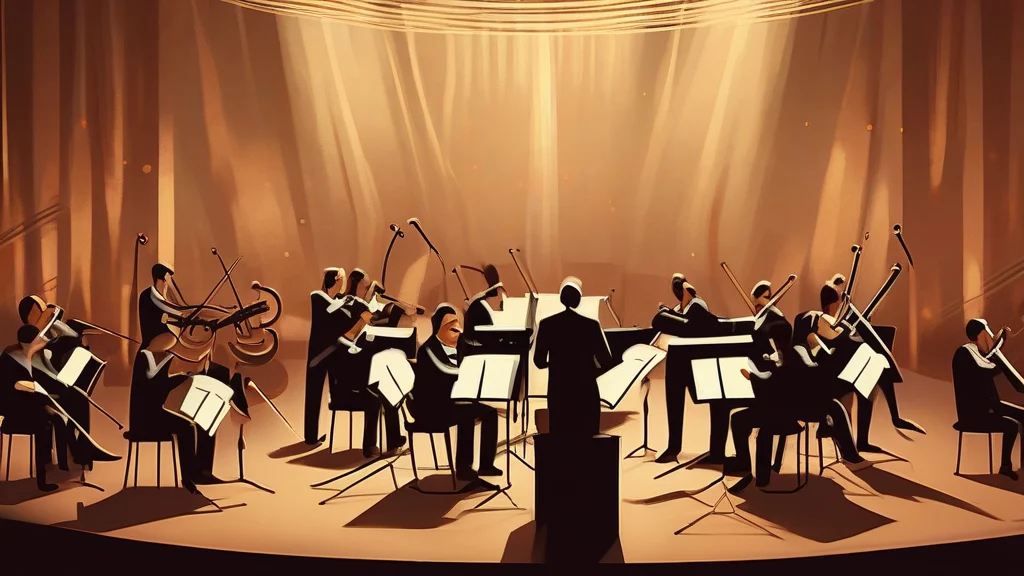
An orchestra is a large ensemble of musicians who perform instrumental music together, usually with different instrumental sections such as strings, woodwinds, brass, and percussion. The word can refer both to the musicians themselves and, occasionally, to the instruments they play. Orchestras are especially associated with classical music, including symphonies and concertos, but they also perform film scores, popular arrangements, and contemporary works. In a concert hall, the ensemble commonly performs from an orchestra pit in front of the audience. The term comes from ancient Greek, where the orchestra was the circular or semicircular area in a theatre used by musicians and dancers. Today, orchestra is both a familiar cultural institution and a useful word for describing coordinated musical forces whose parts combine into a unified performance.
nounA large group of musicians who perform instrumental music together, typically in a concert hall, theatre, or other public venue. The term can also refer to the group of instruments in such an ensemble.
- A large ensemble of musicians who perform instrumental music together.
- The instruments played by such an ensemble, considered as a group.
"The orchestra performed a lively symphony to a packed audience."
"The orchestra tuned its instruments before the concert began."
"The score was written for a full orchestra of strings, woodwinds, brass, and percussion."
The regular plural is orchestras, for example when referring to several ensembles or when discussing orchestras generally.
"The city has several renowned orchestras that perform throughout the season."
The orchestra takes its name from the ancient Greek place reserved for musicians and dancers at the front of the theatre.
Reviewed by Deb Chak, Editor. AI-assisted content curated by RJS Tech Solutions LLP.
Where does orchestra come from?
The English word orchestra comes from the ancient Greek ὀρχήστρα, meaning the part of a theatre where musicians and dancers performed. It entered English through Latin, initially referring to the theatre's performance area and later to the group of instrumental musicians associated with it. The modern sense of a large musical ensemble developed through that progression. The related English words orchestrate and orchestration preserve the underlying idea of arranging and coordinating musical or other complex parts.
Related word forms
How orchestra is actually used
In modern English, orchestra usually refers to a substantial instrumental ensemble, though the word can also be used more broadly for smaller instrumental groups. In British usage, the term may sometimes be associated particularly with a professional or symphony orchestra.
Easily confused with orchestra
An orchestra is the group of musicians, while an orchestration is the arrangement of music for an orchestra or another ensemble.
To orchestrate is to organize and coordinate a complex activity; an orchestra is the musical ensemble that performs the resulting music.