
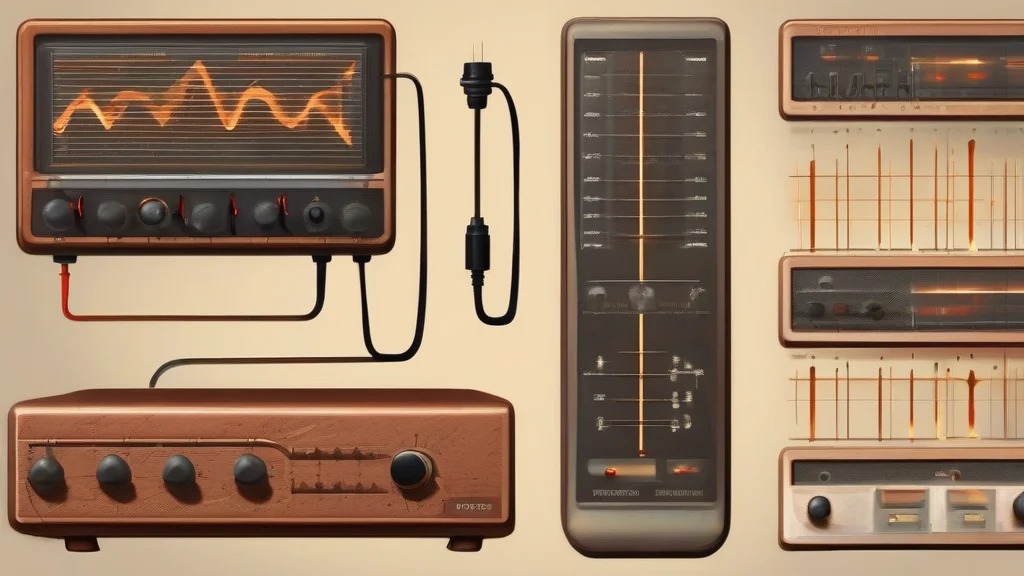
What does oscillograph mean?
An oscillograph is a scientific instrument for displaying or recording an electrical signal as it varies with time. Its name suggests its original function: it produced a graphic record of oscillations, particularly periodic waveforms such as those generated by alternating current or electronic circuits. In laboratory and engineering contexts, an oscillograph made such changes visible or measurable, allowing investigators to examine frequency, amplitude, timing, and shape. The word is formal and technical, and it also carries a historical flavour because electronic oscilloscopes later became the familiar instrument for viewing waveforms. Modern usage sometimes treats oscillograph and oscilloscope as overlapping terms, although an oscillograph may also refer to an earlier recording device rather than a modern screen-based scope. The word remains useful as a precise reminder that measuring an invisible electrical change often begins with turning it into a visible trace.
nounAn instrument that displays or records a graph of an oscillating or periodic electrical quantity, especially as a waveform.
- An instrument that graphically displays or records an oscillating or periodic electrical quantity.
"The engineers connected the amplifier to an oscillograph and examined the resulting waveform on the screen."
"A faulty component produced an unexpected pulse that was immediately visible on the oscillograph."
"His early laboratory used an oscillograph to record the waveform produced by the amplifier."
The plural normally refers to multiple instruments rather than to individual traces or signals.
"The laboratory replaced two obsolete oscillographs with a modern digital oscilloscope."
Long before digital scopes, the oscillograph helped scientists turn invisible electrical motion into a visible trace.
Reviewed by Deb Chak, Editor. AI-assisted content curated by RJS Tech Solutions LLP.
Where does oscillograph come from?
The word was formed in the 19th century in English by combining oscillate with the combining form -graph, denoting an instrument that records or displays. Oscillate was borrowed from Latin oscillare, meaning “to swing,” while -graph comes from Greek graphē, associated with writing or recording. The same Latin root underlies oscillation and oscillator, and it also supplied the initial element of the later compound oscilloscope.
Related word forms
How oscillograph is actually used
A formal technical term with a somewhat historical flavour, used particularly in laboratory, physics, electronics, and engineering contexts rather than everyday speech.
Easily confused with oscillograph
Oscillograph is the older, broader term for an instrument that displays or records oscillatory signals, whereas oscilloscope usually names a modern electronic instrument for viewing such signals; contemporary usage often overlaps.