
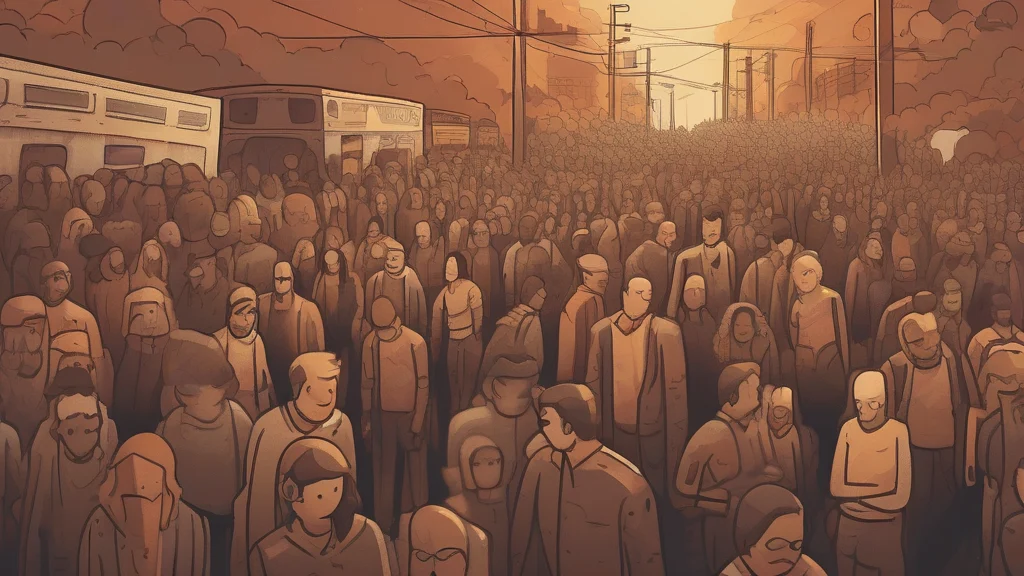
What does overcrowding mean?
Overcrowding names the condition of having more people, animals, or objects in a space or system than it can accommodate comfortably, safely, or effectively. The term is especially common in discussions of housing, schools, hospitals, prisons, and public transport, where excessive density can reduce privacy, increase stress, hinder movement, or raise the risk of disease transmission. It can also refer to the process of packing a place beyond its intended capacity. Unlike the more general word crowding, which can describe ordinary density, overcrowding implies a degree of excess that is problematic. The word is generally neutral and suitable for formal reports as well as ordinary public discussion. In everyday use, it is often paired with “of” to identify what is affected, as in “the overcrowding of hospitals,” while attributive forms such as “overcrowding conditions” are also common. Overall, overcrowding is useful whenever the issue is not merely that many people are present, but that their number has created harmful or impractical pressure on limited space.
The condition of a place or system containing more people, animals, or objects than it can accommodate comfortably or safely.
"Severe overcrowding in the hospital has led to patients being placed in temporary corridors."
Usually used as an uncountable noun, often with "of" or as an attributive modifier.
The act or process of filling a space or institution beyond its intended capacity.
"The report criticized the overcrowding of schools by classes larger than those recommended."
This use focuses on the process or policy rather than the resulting condition.
The noun is normally uncountable. The plural is uncommon but can distinguish separate instances of excessive crowding.
"The survey identified overcrowdings in several separate housing developments."
When a space holds too much life, more can paradoxically mean less: less privacy, less safety, and less room to move.
Reviewed by Deb Chak, Editor. AI-assisted content curated by RJS Tech Solutions LLP.
Where does overcrowding come from?
The word is an English compound of over- and crowding, with the prefix over- indicating excess or too much. Crowding derives from crowd, an Old English word with Germanic roots, and is the source of related forms such as crowded and overcrowd. The compound is transparent in meaning and is now used in general, public-health, housing, transport, and institutional contexts.
Related word forms
How overcrowding is actually used
The word is generally neutral and is common in formal reports, public-health contexts, and everyday discussion. It implies problematic excess, whereas the more general term "crowding" can describe ordinary density without necessarily indicating harm or reduced functionality.
Easily confused with overcrowding
Overpopulation concerns a population's size in relation to available resources, whereas overcrowding concerns excessive concentration in a particular place, building, or institution.