
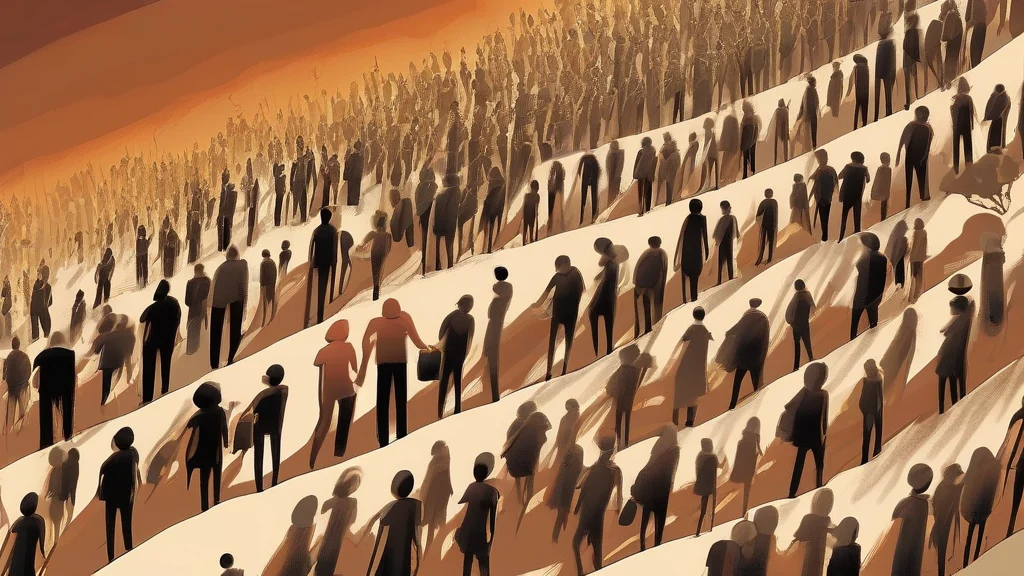
What does overpopulation mean?
Overpopulation is a noun meaning the condition of a population being too large for the resources, services, or environmental capacity available to support it. The term is commonly used in demography, public health, economics, environmental studies, and development policy. It may refer to a local population putting pressure on housing, water, food, healthcare, or jobs, or to excessive population growth viewed as a global issue. Although overpopulation does not require physical crowding, the two ideas are often associated because crowded conditions can make limited resources more difficult to distribute. The word is generally more precise than simply saying that a place is crowded, because its central concern is the relationship between population size and available capacity. Its use can also carry political or moral overtones, so discussions often need to address resource distribution, consumption, governance, and differing regional circumstances.
nounThe condition of a population being too large in relation to the available resources, services, or environmental capacity. It can also refer more broadly to excessive population density or growth in a particular area.
- The condition of a population being excessively large in relation to available resources, infrastructure, or environmental capacity.
"Rapid population growth has raised concerns about overpopulation and the resulting pressure on food and water supplies."
"Rapid population growth has raised concerns about overpopulation and the resulting pressure on food and water supplies."
"The lecture examined how overpopulation can affect public health, housing, and access to education."
Rare in modern usage; the singular is normally preferred even when different regions or populations are being discussed.
"The study compares overpopulations in several cities with very different resource levels."
Overpopulation does not simply mean that a place has many people; it means that its population has outgrown what the place can support.
Reviewed by Deb Chak, Editor. AI-assisted content curated by RJS Tech Solutions LLP.
Where does overpopulation come from?
Overpopulation is a modern English compound of over-, meaning excess or too much, and population. Population came through Old French from Latin populātiō, a noun of action derived from populus, meaning people or populace. The related English words populate, populous, and depopulate reflect the same Latin root.
How overpopulation is actually used
Generally formal and analytical, especially in discussions of demography, public health, environmental policy, and development. It can sound judgmental when applied without considering how resources are distributed or the historical circumstances of a community.
Easily confused with overpopulation
Overpopulation is the broader condition of having too many people for available resources or capacity, whereas overcrowding specifically refers to people being physically crowded into insufficient space.