
What does oviform mean?
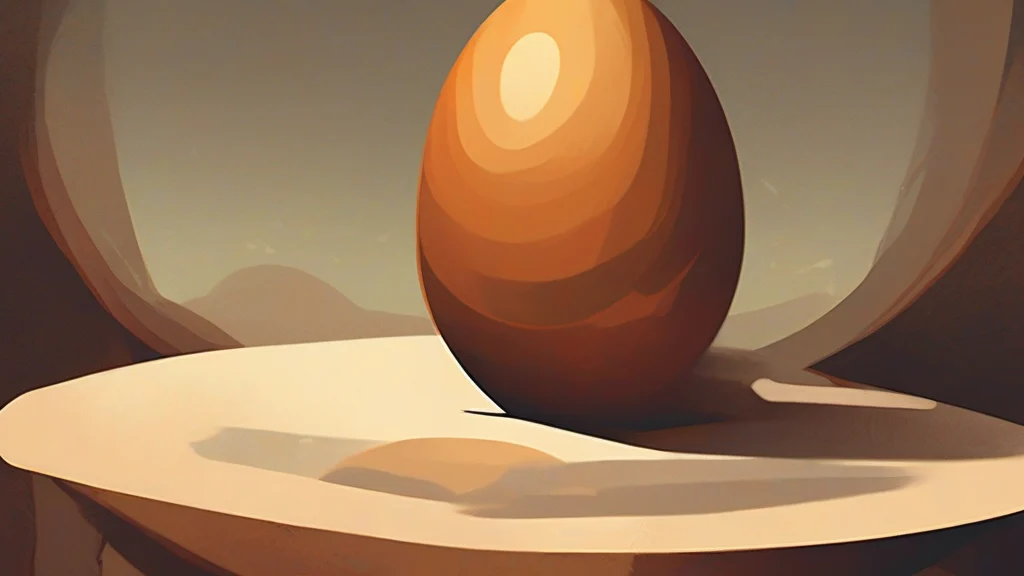
Oviform is a formal adjective meaning “egg-shaped.” It describes any object, cavity, organism, or outline whose overall form resembles an egg, without necessarily implying that it belongs to an egg or has been produced by one. The word is especially useful in technical descriptions in anatomy, biology, paleontology, geology, and related fields, where a precise geometric label can be preferable to the everyday phrase “egg-shaped.” It can characterize physical structures and their outlines: for example, a specimen may have an oviform cavity, while a fossil may retain an oviform shape. Although understandable to modern readers, oviform is relatively uncommon in general writing and is more likely to appear in scientific, academic, or descriptive prose. Its compound formation from the Latin words for “egg” and “shape” makes its meaning both transparent and memorable.
adjectiveHaving the shape of an egg; egg-shaped.
- Shaped like an egg.
"The fossil preserved the oviform outline of the organism's shell."
"The structure has a smooth, oviform surface."
"Researchers identified several oviform cavities within the rock."
Oviform literally announces its meaning: its roots combine “egg” and “shape,” making it a precise label for an egg-like outline.
Reviewed by Deb Chak, Editor. AI-assisted content curated by RJS Tech Solutions LLP.
Where does oviform come from?
Oviform was formed in the 19th century from Latin ovum, meaning “egg,” together with the element -iform, derived from Latin forma, meaning “shape.” The same Latin root underlying ovum also appears in English words such as oval, ovate, and ovule.
How oviform is actually used
This is a rare, formal or specialized adjective, used chiefly in anatomy, biology, paleontology, geology, and descriptions of objects or forms. It is more technical than the ordinary phrase “egg-shaped.”
Easily confused with oviform
Oviform means egg-shaped in general, while ovate more specifically describes a shape that is broader toward one end and narrower toward the other.