
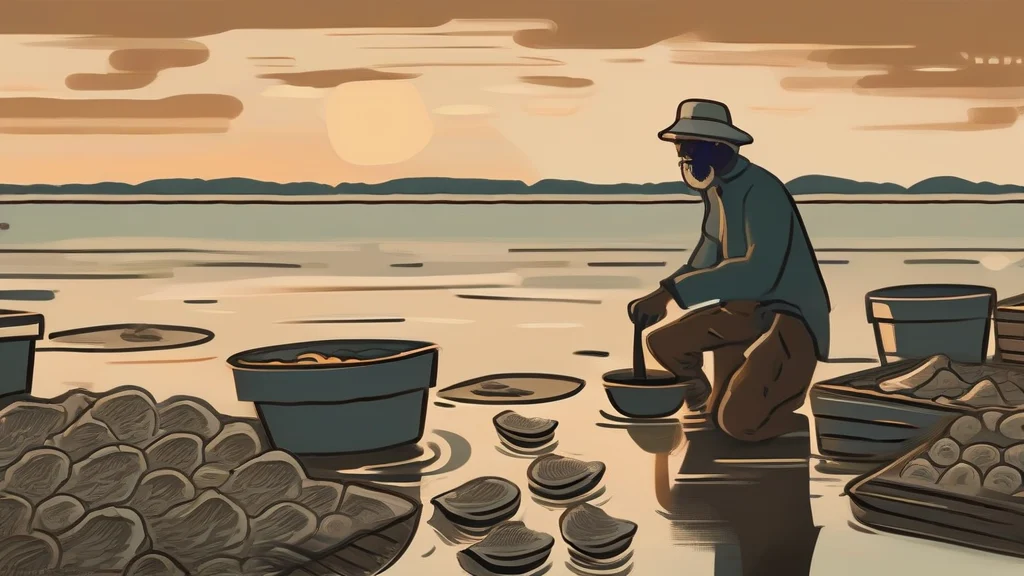
What does oysterer mean?
An oysterer is a person who gathers oysters, cultivates oyster beds, or sells oysters. The word can cover work from extraction to sale, although in contemporary English it is less common than the more specific "oyster farmer" or "oyster dealer." It has an occupational, slightly old-fashioned tone and is associated with coastal communities and the shellfish trade. In a sentence such as "Every morning, the oysterer unloaded his catch at the market," it identifies the person who does the work rather than the mollusk itself. The term remains useful because it preserves the occupational history of coastal communities, while also suggesting the skill, trade, and local character of oyster production. It can refer broadly to someone involved in the industry or more narrowly to a person who gathers or cultivates oysters.
nounA person who gathers oysters, cultivates oyster beds, or deals in oysters.
- A person who cultivates oyster beds or gathers oysters from them.
- A person who sells oysters or operates an oyster-selling business.
"Every morning, the oysterer unloaded his catch at the market."
"Each summer, the oysterer returned with baskets of oysters from the tidal beds."
"The guild represented oysterers who sold shellfish from the city's warehouses."
The standard plural is formed by adding "-s" to the singular noun.
"The town's oysterers worked from dawn until the midday tide had passed."
An oysterer's trade carries a hidden anatomical connection: "oyster" ultimately derives from a Greek word meaning "bone."
Reviewed by Deb Chak, Editor. AI-assisted content curated by RJS Tech Solutions LLP.
Where does oysterer come from?
Oysterer is an English occupational noun formed by adding the suffix "-er" to "oyster." Oyster entered Middle English from Anglo-French oister, ultimately from Latin ostrea, which derives from Greek ostreon, related to osteon, meaning "bone." Related English forms include ostracean and ostreid, both denoting members or relatives of the oyster family.
How oysterer is actually used
The word has an occupational and somewhat old-fashioned tone. In modern English, "oyster farmer" and "oyster dealer" are often more specific and more common.
Easily confused with oysterer
An oyster is the mollusk itself, whereas an oysterer is a person who gathers, cultivates, or sells oysters.