
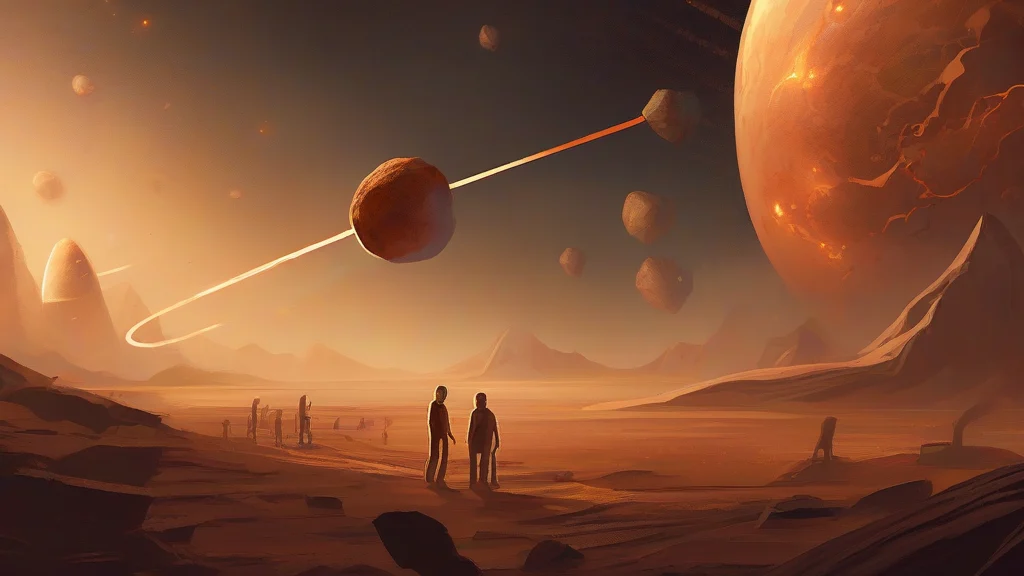
What does panspermia mean?
Panspermia is the hypothesis that life, or material capable of contributing to life, can travel between planets and other parts of the universe. Rather than requiring life to begin independently from lifeless matter on each world, the idea proposes that organisms, spores, seeds, or organic molecules may already be present elsewhere and be carried through space by meteorites, comets, or interstellar dust. The phrase is most often associated with the panspermia hypothesis and with the study of whether life-bearing material could have reached Earth or seeded another planet. Although the general concept is attractive and testable in limited respects, it does not by itself explain how life originally arose; it shifts the question of life's origin to another time or place. Panspermia remains a significant subject in astrobiology, particularly in investigations of organic molecules in space and the possible survival of microscopic organisms during cosmic travel.
nounThe hypothesis that life exists elsewhere in the universe and may have been transported between planets by meteorites, comets, or interstellar dust. It is also used more broadly for the idea that life-bearing material circulates throughout the cosmos.
- The hypothesis that life or life-bearing material is transported between planets or other locations in the universe, potentially seeding new organisms or populations.
"The team examined whether material captured from a high-altitude cloud could support the panspermia hypothesis."
"Scientists continue to study comets and meteorites as possible vehicles for panspermia."
"The discovery of complex organic molecules in space encouraged renewed interest in the panspermia hypothesis."
Normally used as an uncountable singular noun. Rare plural forms are not standard in general usage.
"Panspermia remains a subject of ongoing research in astrobiology."
Panspermia turns the cosmos into a network of potential delivery routes: a bacterium, seed, or organic molecule could cross vast distances and help life begin elsewhere.
Reviewed by Deb Chak, Editor. AI-assisted content curated by RJS Tech Solutions LLP.
Where does panspermia come from?
The word comes from Greek pan, meaning “all,” and sperma, meaning “seed,” reflecting the ancient idea of seeds distributed everywhere. The modern scientific hypothesis was prominently developed by Swedish chemist Svante Arrhenius in 1908, when he proposed that radiation pressure could carry microscopic particles and spores from planet to planet. The term belongs etymologically to a family of Greek words built on pan, such as pandemic, and on sperma, such as sperm and spermatophyte.
Related word forms
How panspermia is actually used
The term is primarily scientific and is normally used with hypotheses concerning the origin or distribution of life in the universe. It is distinct from the related, narrower idea of lithopanspermia, in which rocky material carries microscopic organisms between worlds.
Easily confused with panspermia
Panspermia proposes that existing life or its building materials travel through space, whereas spontaneous generation was the old idea that living organisms can arise directly from nonliving matter.