
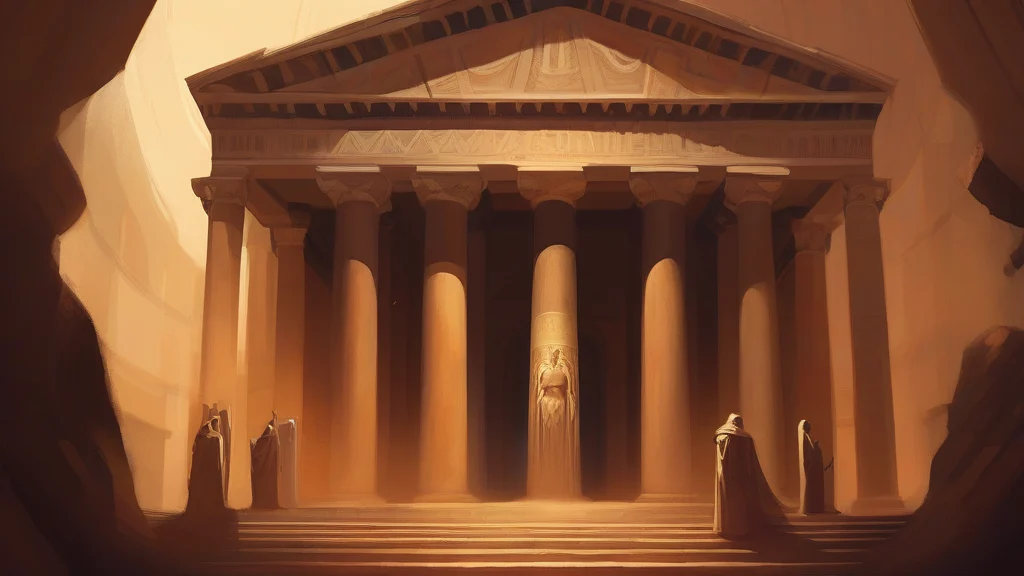
What does pantheon mean?
A pantheon is, in its oldest sense, all the gods considered together or a building devoted to all the gods. Its most famous referent is the Pantheon in Rome, an ancient building whose name reflects this universal religious purpose. In modern figurative use, the word denotes an exceptional group of people who have become central examples in a common field, as in “a pantheon of contemporary writers” or “a pantheon of jazz musicians.” This use conveys admiration and implies that the individuals have lasting importance rather than merely sharing the same profession. The word therefore combines a historical religious meaning with a modern metaphor for cultural stature. It is especially useful when a speaker wants to portray a group not simply as collaborators or contemporaries, but as defining figures whose influence has made them representatives of their field.
nounThe collective body of all the gods or, by extension, a temple dedicated to all the gods, especially the ancient Roman building known as the Pantheon. Figuratively, a pantheon is a distinguished group of celebrated people regarded as exemplars in a shared field.
- All the gods regarded collectively, especially in Greek and Roman religion.
- A temple or building dedicated to all the gods, especially the Pantheon in Rome.
- A distinguished collection or company of celebrated people within a shared field.
"Her anthology presents the poets of the Harlem Renaissance as a pantheon of influential American voices."
"Visitors have admired the Pantheon in Rome since antiquity."
"The festival's programming honored a pantheon of artists whose work shaped contemporary dance."
The regular plural refers to separate collections of gods or to different groups of figures regarded as distinguished exemplars.
"The exhibition brought together regional pantheons of performers, painters, and architects."
Nearly two millennia after it was built, the Pantheon still opens to the sky through its oculus and remains one of the ancient world's most awe-inspiring structures.
Reviewed by Deb Chak, Editor. AI-assisted content curated by RJS Tech Solutions LLP.
Where does pantheon come from?
The English word entered English in the 16th century through French, from Latin pantheon. Latin pantheon came from Greek pantheion, a temple of all the gods, formed from pan, meaning “all,” and theos, meaning “god.” The same Greek elements underlie related words such as theology and polytheism, while pantheism develops the concept of a divine or godlike unity encompassing all reality.
How pantheon is actually used
The word is generally formal and often literary. Its figurative use is strongly laudatory, presenting a group of people as a canonical collection of major figures. The Roman building is normally capitalized, while the general and figurative senses generally take a lowercase article.
Easily confused with pantheon
The Pantheon is a Roman building associated with the city's patron gods, whereas the Parthenon is an ancient Athenian temple dedicated specifically to Athena.