
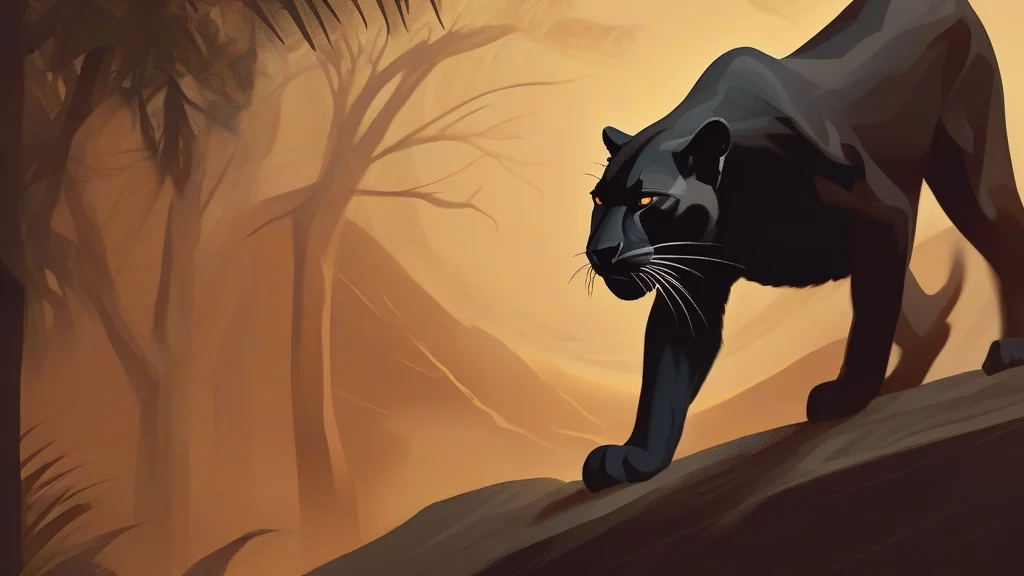
What does pantherine mean?
Pantherine is a formal adjective meaning resembling a panther or having qualities traditionally associated with one. It evokes the animal's suppleness, alertness, strength, and restrained movement, often in descriptions of people, animals, art, or movement. A sentence such as “the dancer moved with pantherine grace” uses the word chiefly for an elegant, controlled, and powerful quality. Although the suffix '-ine' also appears in numerous unrelated adjectives, pantherine is transparent in meaning: it belongs to the family of forms derived from “panther.” The word is uncommon in casual speech and tends to occur in descriptive or literary prose, where it can lend an image or behaviour a sense of controlled power.
adjectiveResembling a panther in appearance or bearing; characteristic of a panther.
- Resembling or characteristic of a panther.
"The cat moved across the garden with pantherine grace."
"Her pantherine stride carried her silently through the tall grass."
"The sculpture depicts a powerful, pantherine figure poised to leap."
Pantherine is a literary label for the lithe, watchful grace associated with a panther.
Reviewed by Deb Chak, Editor. AI-assisted content curated by RJS Tech Solutions LLP.
Where does pantherine come from?
Pantherine was formed in English by adding the adjective-forming suffix '-ine' to “panther.” The word “panther” entered English through Old French from Latin panthera, which was borrowed from Greek panthēr. Although panther and pantherine are not strict cognates in the linguistic sense, they plainly share the same base and differ through the added suffix.
How pantherine is actually used
This is a formal or literary adjective rather than everyday vocabulary. It is chiefly used for visible appearance, movement, or bearing and should not be treated as a scientific taxonomic designation by itself.