
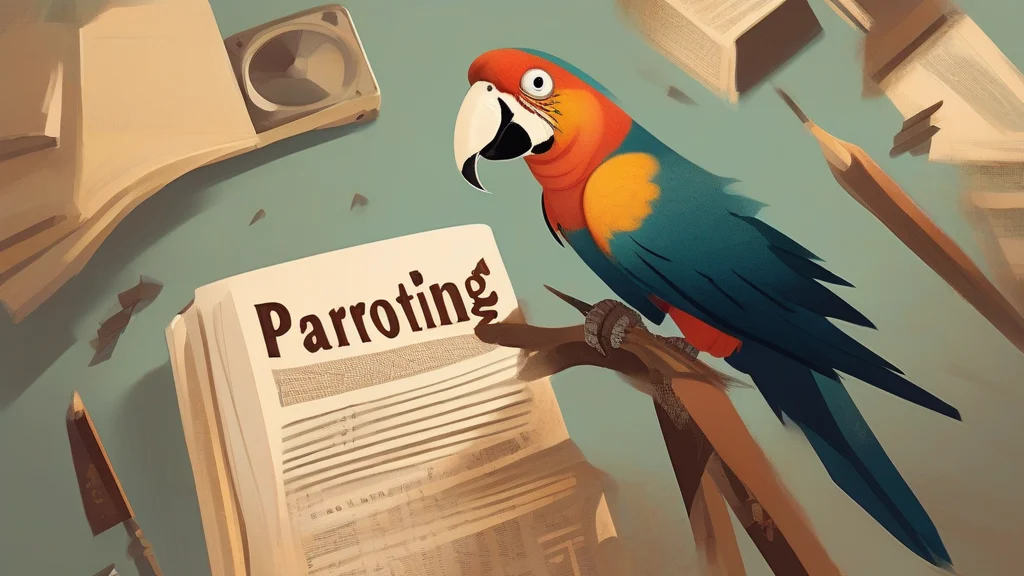
What does parroting mean?
Parroting means repeating someone else's words or ideas, usually by imitation and often without understanding or critically evaluating them. The expression can describe a child copying a relative, a speaker mechanically repeating a phrase, or an organization endorsing an established position without adding meaningful analysis. Its critical connotation arises because parroting contrasts with thinking, interpreting, and responding independently: to parrot a claim is not necessarily to accept it. The word can therefore imply mindless repetition, but its tone depends on context. In neutral or descriptive writing, parroting may simply refer to accurate repetition or imitation, including the vocal behavior associated with parrots. Used metaphorically, however, it is especially effective for criticizing agreement that is automatic, unoriginal, or insincere.
verbTo repeat or imitate someone else's words, typically without understanding, reflecting, or adding to their meaning. It can also mean to reproduce a statement, idea, or behavior in a way that appears supportive but is uncritical.
- To repeat or imitate another person's words, often mechanically or without understanding.
- To endorse or repeat another person's opinion or position without critical thought.
- To copy or reproduce a phrase, sound, or piece of information in a repetitive manner.
"Several members of the committee simply parroted the chairman's proposal without discussing its merits."
"The child parroted her sister's explanation until she could almost recite it by heart."
"Rather than parroting the organization's familiar policy, the author offered a thoughtful argument for changing it."
Calling someone out for parroting you is calling out not their disagreement, but their failure to think for themselves.
Reviewed by Deb Chak, Editor. AI-assisted content curated by RJS Tech Solutions LLP.
Etymology of parroting
“Parroting” was formed in English by adding the present-participle suffix -ing to the verb “parrot.” The word “parrot” entered Middle English from Old French perrot; its ultimate origin is uncertain, although it is often associated with the repeated speech of the bird. The longer history of “parroting” follows the metaphorical development of the bird's conspicuous ability to imitate human speech.
Related word forms
How parroting is actually used
The term is mildly critical when it describes repeating another person's ideas without independent thought. In literal descriptions of birds or sound imitation, it can be neutral or approving.