
What does pawl mean?
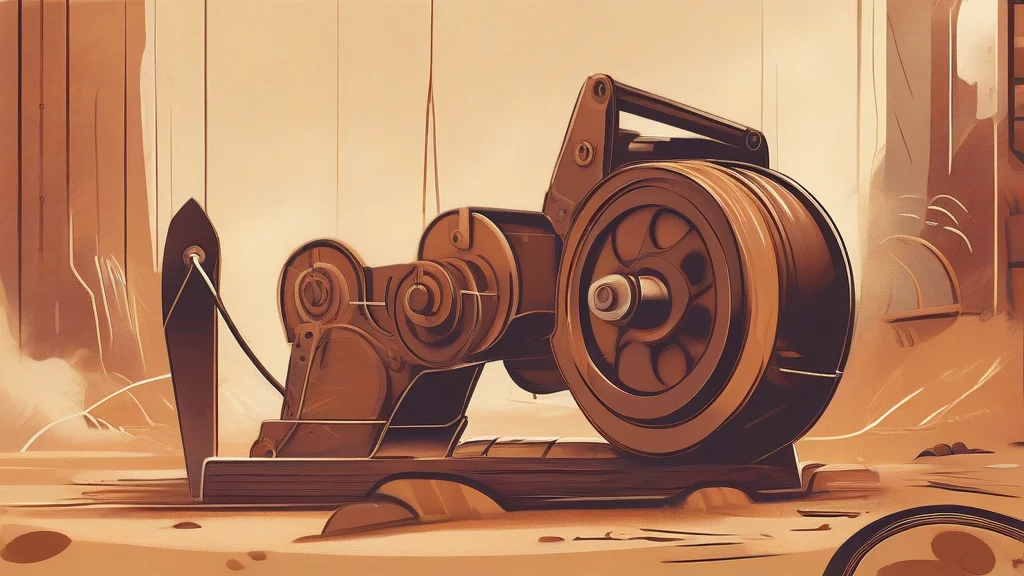
A pawl is a small mechanical catch that engages the teeth of a ratchet, gear, or similar device. Its purpose is to permit movement in one direction while preventing, or greatly limiting, movement in reverse. The characteristic sound of many mechanisms is described as a click: that sound is often produced when a spring-loaded pawl drops into or lifts from a sequence of teeth. Pawls occur in winches, hand brakes, cable drums, locks, clocks, and watches, although they are also used in many more specialized machines and instruments. The word is primarily technical, but it can be used figuratively for anything that restrains a process from retreating or reversing. A pawl differs from the ratchet itself: the ratchet is the toothed wheel or bar, while the pawl is the separate member that catches against its teeth. The distinction is useful when discussing tools, escapements, and safety mechanisms.
nounA hinged, pivoted, or sliding catch that engages the teeth of a ratchet or another toothed mechanism, allowing motion in one direction while preventing or limiting motion in reverse.
- A pivoted or sliding catch that engages the teeth of a ratchet or similar mechanism and prevents or limits reverse motion.
- A lever in a clock, watch, lock, or other mechanism that alternately checks and releases a moving part.
"The ratchet's spring-loaded pawl clicked into each successive tooth."
"A worn pawl allowed the winch handle to slip backward."
"The clock's pawl stopped the escape wheel from recoiling between ticks."
The regular plural is pawls.
"Both pawls were worn smooth."
A pawl is the tiny 'click' that lets a mechanism move forward—but never backward.
Reviewed by Deb Chak, Editor. AI-assisted content curated by RJS Tech Solutions LLP.
Where does pawl come from?
The word appeared in English in the early seventeenth century with the mechanical sense already established. It is generally traced through French to Medieval Latin pala, meaning a spade or shovel, by analogy with a projecting part that catches like a shovel. Related forms include the English words palette and the rare sense of pale meaning a shovel.
How pawl is actually used
Pawl is chiefly a technical term used in mechanical engineering, horology, locksmithing, and the maintenance of ratcheting or winding mechanisms. It is uncommon in general conversation.
Easily confused with pawl
A pawl is a mechanical catch that prevents backward motion, whereas a pall is a cloth covering, especially one placed over a coffin.
A pawl is a small locking component in a mechanism, while a pallet is a platform for supporting goods or a low bed.