
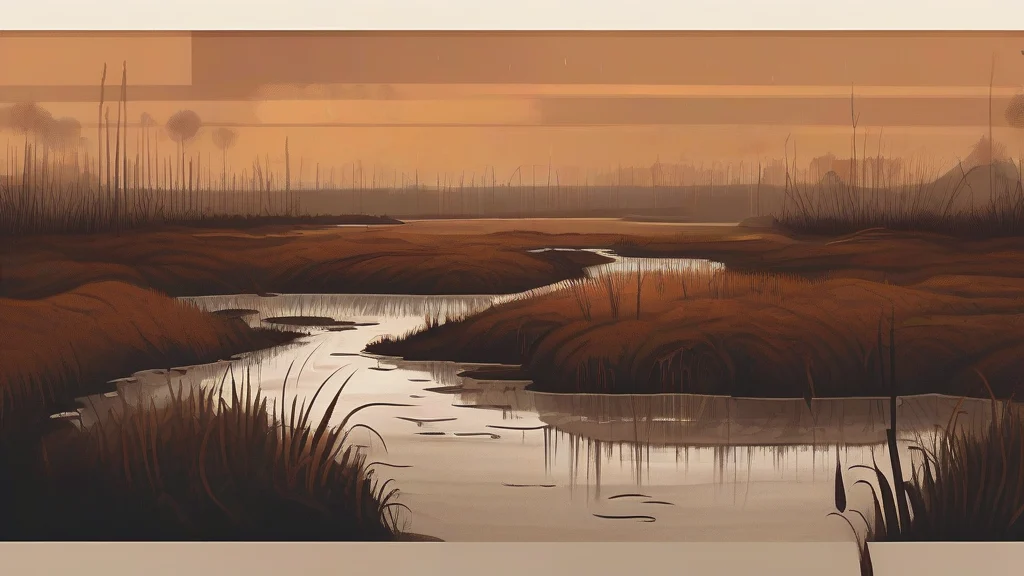
What does peatland mean?
Peatland is land made up of peat, the partially decomposed remains of plants such as mosses, sedges, and trees. It usually forms in cold, wet, poorly drained environments where waterlogged, oxygen-poor conditions slow the breakdown of organic material. The word is especially associated with the bog and mire landscapes of Britain, Ireland, and northern Europe, but it is also used for comparable ecosystems elsewhere, including parts of North America and Asia. In environmental and conservation writing, peatland refers not just to isolated pools or hollows but to larger landscapes where peat accumulation is characteristic. These areas can support highly specialized plants, animals, and fungi, and they may preserve archaeological or ecological remains. Peatland is also important in climate discussions because disturbed or drained peat can release stored carbon as carbon dioxide. The term is therefore more geographically and ecologically precise than “wetland,” which is a much broader category.
nounLand consisting of or covered with peat, typically in a wet, poorly drained environment. The term is also used for regions where peat-forming wetlands dominate the landscape.
- Land consisting of or covered with peat, especially a wet, low-lying area where peat accumulates.
"The conservation team worked to restore the peatland and protect its distinctive wildlife."
"Peatland across northern Europe is among the most sensitive ecosystems in the region."
"The report describes the conversion of peatland into productive farmland as a major source of carbon emissions."
Usually used as a mass noun when referring to peat-forming terrain generally; the plural “peatlands” is appropriate for distinct geographical areas or landscapes.
"Several peatlands across the island are protected under conservation law."
Peatland is both a landscape and a time capsule, preserving organic remains because its wet, oxygen-poor conditions slow decay.
Reviewed by Deb Chak, Editor. AI-assisted content curated by RJS Tech Solutions LLP.
Where does peatland come from?
Peatland is an English compound formed from “peat” and “land.” Both elements are native English words: “peat” has an Old and Middle English ancestry, while “land” continues Old English “land,” referring to solid ground or territory. The compound’s sense developed from the material peat to the larger area of land in which it occurs, and related forms such as “peaty” and “peat bog” reflect the same English root.
Related word forms
How peatland is actually used
Peatland is especially common in geography, ecology, conservation, and climate-policy contexts. In general usage, “bog” or “peat bog” may be used for a smaller or more specific feature, while “peatland” often denotes a broader landscape.
Easily confused with peatland
Peat is the partially decomposed organic material itself, whereas peatland is the land or landscape in which peat accumulates.
A bog is a wet, peat-filled area of ground, while peatland can refer more broadly to an entire peat-forming landscape or region.