
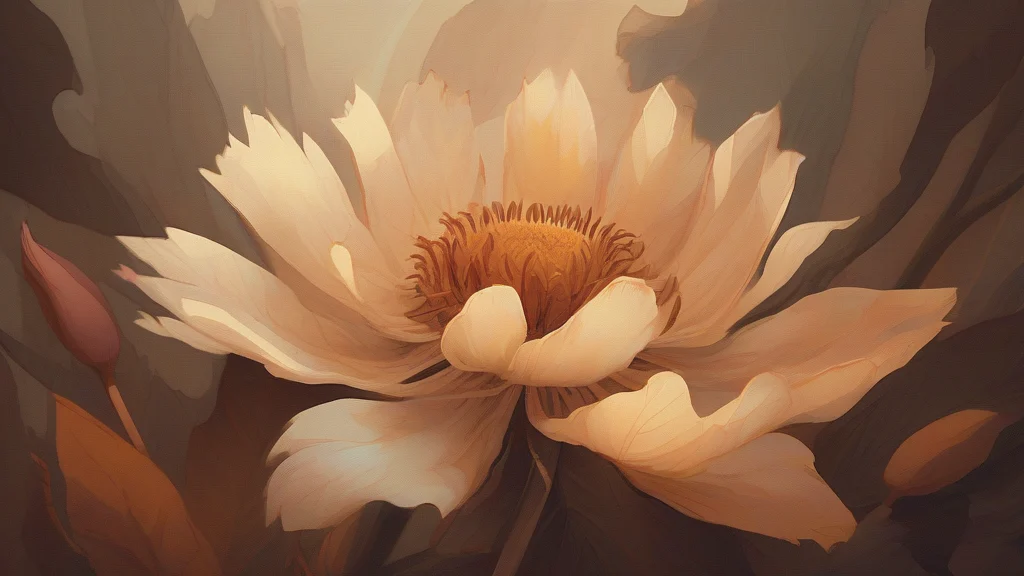
What does perianth mean?
A perianth is the collective outer covering of a flower, normally comprising its sepals and petals. The term is useful in botany because the two groups often have different functions even when they look similar: sepals generally protect a developing bud, while petals commonly attract pollinators and help direct them toward the flower’s reproductive structures. In some specialized contexts, especially where floral organs are not clearly divisible into sepals and petals, perianth may refer more broadly to the entire non-reproductive envelope. A botanist might describe a flower as having a colourful, spotted, persistent, or fragrant perianth. The word is distinct from calyx, which denotes only the sepals, and from corolla, which denotes only the petals. In everyday discussion, a calyx or corolla is usually more precise, but the perianth provides a concise term for the two components considered together.
nounThe collective term for the sepals and petals that form the non-reproductive envelope of a flower. In some contexts, the term also refers to the entire outer floral envelope, including organs that are not conventionally classified as either sepals or petals.
- The collective outer envelope of a flower, comprising the sepals and petals.
- In specialized botanical usage, the entire non-reproductive floral structure, sometimes including organs that cannot be cleanly separated into sepals and petals.
"The flower has a vivid red perianth that opens wide in the morning sunlight."
"Each bloom on the orchid has a delicately patterned perianth of six spreading segments."
"The botanist noted that the perianth persists around the fruit long after the flower has faded."
The regular plural is perianths; perianth is also used unchanged in some botanical contexts, particularly when discussing the structure collectively.
"The orchid produces two distinct perianths, one on each of its paired flowers."
A flower has two celebrated layers: its perianth dresses the show, while its stamens and pistil carry out the reproductive business.
Reviewed by Deb Chak, Editor. AI-assisted content curated by RJS Tech Solutions LLP.
Where does perianth come from?
The word comes through Latin from Greek perianthos, a compound of the prefix peri-, meaning “around,” and anthos, meaning “flower.” The Greek form referred to the structures surrounding a flower’s reproductive organs. Its scientific sense developed alongside botanical terminology, with the word becoming a general term for the floral envelope composed of sepals and petals.
Related word forms
How perianth is actually used
This is primarily a botanical term. It is especially useful when referring collectively to sepals and petals, but the more specific terms calyx and corolla are preferable when discussing only one of those structures.
Easily confused with perianth
The calyx is the collective term for the sepals alone, whereas the perianth generally includes both the sepals and the petals.
The corolla consists of the petals alone, whereas the perianth is the broader floral envelope formed by sepals and petals together.