
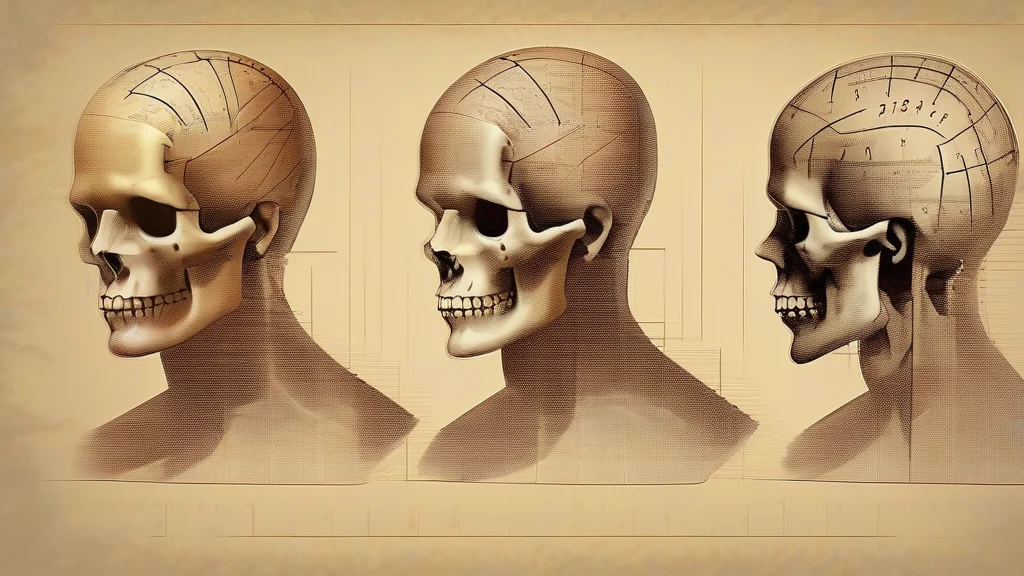
What does phrenology mean?
Phrenology was a 19th-century doctrine that purported to reveal a person's character and intellectual abilities from the shape of the skull. Practitioners assumed that different parts of the brain governed specific traits and that the resulting mental faculties influenced the skull's outward form. By inspecting cranial bumps and the relative proportions of different areas of the head, phrenologists assigned personalities and estimated abilities. The theory attracted wide attention and was used to support many harmful social hierarchies, including claims about race, gender, class, and criminality. Although influential figures in early neuroscience and anatomy helped develop the system, its central premise lacked a reliable scientific basis. Phrenology was ultimately rejected when experimental evidence and improved knowledge of brain anatomy contradicted its claims. Today, the word is chiefly used when discussing the history of pseudoscience, the misuse of scientific authority, or the history of racial and gender prejudice.
nounA discredited 19th-century doctrine that claimed the shape and bumps of a person's skull could reveal their character, intelligence, and other mental traits. The theory is now recognized as pseudoscientific and historically significant rather than scientifically valid.
- The historical doctrine that the shape and bumps of the skull reveal a person's character, intelligence, and other mental characteristics.
"Nineteenth-century phrenology was often used to justify ideas about race, gender, and social rank."
"The museum offers a guided tour of the equipment once used to measure heads in the practice of phrenology."
"Her lecture explains how phrenology was adapted to support racist and sexist hierarchies in the 19th century."
Usually plural when referring to the theories or practices of different phrenologists, or to comparable systems in different societies.
"The histories compare phrenologies in Europe and the United States."
Phrenology's dark irony is that a pioneering effort to read personality from the skull became one of history's most notorious examples of pseudoscience.
Reviewed by Deb Chak, Editor. AI-assisted content curated by RJS Tech Solutions LLP.
Where does phrenology come from?
The word was formed in the early 19th century from Greek phrēn, meaning “mind,” and the combining form -logy, meaning “study of.” It was also used in French as phrénologie before and alongside its development in English. Its components belong to a wider Greek vocabulary associated with the mind, including phrenic and frenzy.
Related word forms
How phrenology is actually used
The term is now chiefly historical or critical. In contemporary use it usually denotes a discredited pseudoscience rather than a legitimate method of assessing personality.
Easily confused with phrenology
Physiognomy is the broader practice or study of interpreting facial features as indicators of character, whereas phrenology specifically claimed that cranial shape reflected mental and personality traits.