
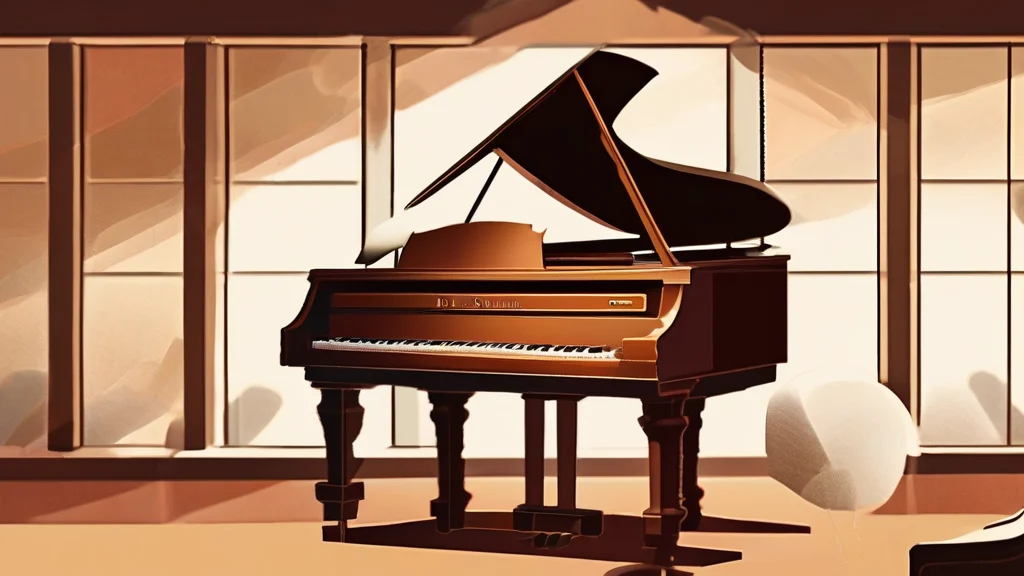
What does pianola mean?
A pianola is a self-playing piano that converts coded instructions, traditionally perforated paper rolls, into the movements of its keys and hammers. Its mechanism may use compressed air or other mechanical power to reproduce a performance. Pianolas became prominent in the late nineteenth and early twentieth centuries, appearing in homes, public entertainment venues, and commercial establishments. Their automatic playing also gave rise to a substantial repertoire composed specifically for the instrument. Although the term has declined in everyday use, it remains associated with a distinctive branch of musical history and with the visual culture of perforated rolls and moving piano mechanisms. In modern descriptions, “pianola” can therefore refer either to the instrument itself or to music intended for such a mechanism, while “player piano” is a broader descriptive alternative.
nounA self-playing piano in which air pressure and perforated paper rolls operate the keys and hammers. The term is also used more generally for music written for performance by such a mechanism.
- A self-playing piano whose mechanism uses air pressure to translate encoded instructions into key and hammer movements.
- Music composed or arranged for performance by a pianola or a similar self-playing mechanism.
"The old pianola in the corner continued to play while nobody was in the room."
"They found a box of pianola rolls beside the instrument at the antique shop."
"The piece was originally conceived as pianola music rather than for a pianist at a concert grand."
Used when referring to multiple self-playing pianos or instruments of this kind.
"Two restored pianolas were displayed in the museum."
A pianola turns punched-paper instructions and compressed air into music, making one of history's most theatrical early forms of automation.
Reviewed by Deb Chak, Editor. AI-assisted content curated by RJS Tech Solutions LLP.
Where does pianola come from?
The word comes from Italian, where it is a diminutive of “piano” and thus means roughly “little piano.” “Piano” itself belongs to the Italian family of terms derived from the name of the instrument, whose keyboard hammers originally gave it the name “pianoforte.” The diminutive was applied to the self-playing instrument during the nineteenth century and subsequently entered English.
How pianola is actually used
The word is now chiefly historical or nostalgic, though it remains intelligible when referring to self-playing pianos and their music. In modern usage, it may connote an old-fashioned mechanical novelty rather than a contemporary musical instrument.
Easily confused with pianola
A pianola plays automatically from encoded instructions, whereas a piano is ordinarily played directly by a pianist.