
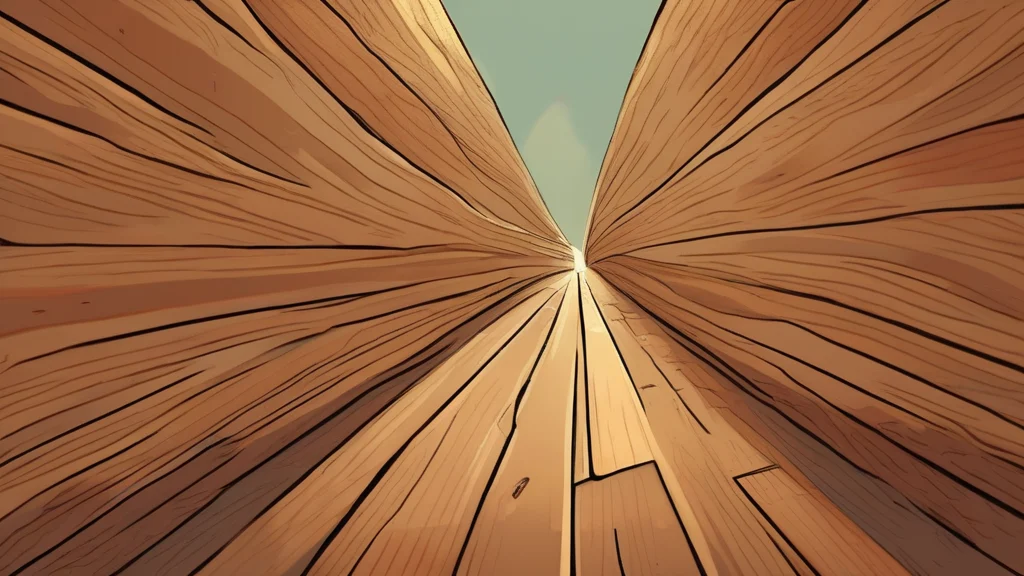
What does plank mean?
A plank is a long, flat board of wood used in construction, flooring, fencing, and other practical work. The word can also refer to one of the individual policies or principles in a political platform, a usage that developed from the idea of platform boards fitted together. In its less common verbal form, plank means to cover or furnish something with wooden boards. The noun is familiar in descriptions of buildings, boats, and handmade objects, while the political sense often implies a clearly defined policy position. Phrases such as “walk the plank” preserve the word's strong association with wooden platforms and maritime or historical imagery. Together, these senses make plank a useful example of how a concrete physical object can acquire an abstract political meaning through metaphor.
A long, flat, narrow piece of wood, usually used as part of a structure or surface. In political language, a plank is an individual policy or principle in a party platform.
"The builders fastened the final plank across the wooden frame."
The political sense is usually used in the plural, especially in discussions of party platforms.
To lay or fasten planks over or onto a surface, especially a floor or wall.
"They planked the walls before applying the insulation."
This is a practical and relatively uncommon verb, chiefly used for construction or carpentry.
The plural is the standard form for multiple pieces of wood and is especially common in the political sense of a party's individual policy positions.
"The platform included planks on taxation, education, and public transport."
A political platform is made of “planks” because each plank was once a separate board; the metaphor turned individual policies into parts of a unified platform.
Reviewed by Deb Chak, Editor. AI-assisted content curated by RJS Tech Solutions LLP.
Where does plank come from?
The word comes through Old French from Latin planca, meaning a flat board or plank. The Latin word is related to planus, “flat” or “level,” the source of English plane and plan. The political sense developed later by analogy with the planks that make up a platform, and the verb developed from the physical use of wooden boards to cover or furnish a surface.
Related word forms
How plank is actually used
The noun is neutral in ordinary use. In political contexts, “planks” commonly refers to the individual policies or commitments in a party platform. “Walk the plank” is a traditional figurative idiom, and “plank” as a verb is less common than the corresponding noun.
Easily confused with plank
A plan is a proposed course of action or arrangement, whereas a plank is physically a length of wood or, in politics, one policy point within a platform.