
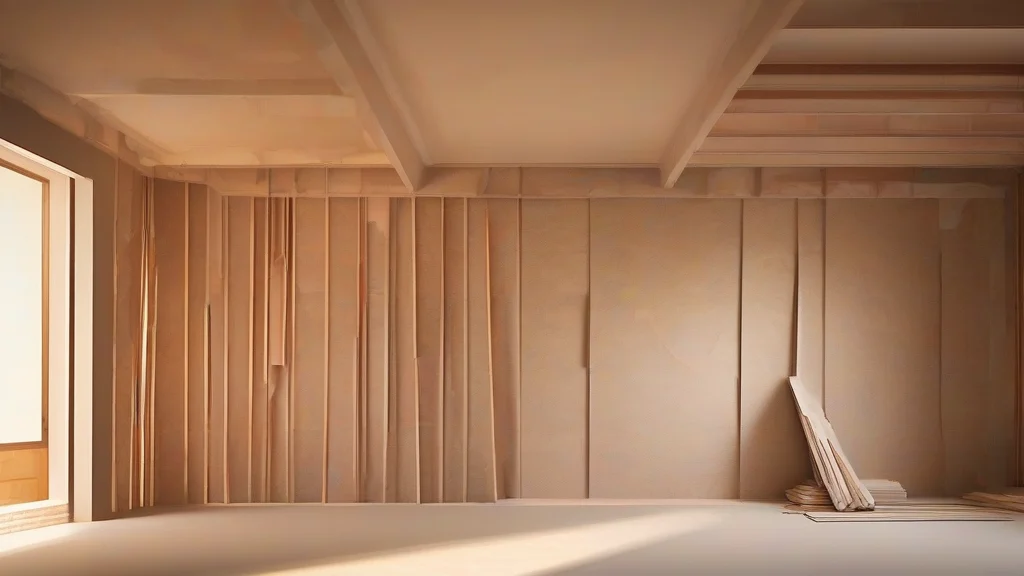
What does plasterboard mean?
Plasterboard is a factory-made sheet material used to line walls and form ceilings. It consists of a layer of plaster, usually gypsum-based, enclosed between sheets of paper. The material is especially important in British English, where it is commonly called plasterboard; North American speakers usually say drywall, though the two terms can overlap in technical use. Plasterboard differs from traditional plaster because it arrives as portable panels rather than being applied wet to lath. It can be cut, fixed to timber or metal supports, taped, and finished with joint compound, making it a standard way to create smooth interior surfaces. The term normally names the material as a mass noun, though plasterboards is used for separate sheets. Plasterboard is not merely another word for plaster: the two are related ingredients and techniques, but their forms, uses, and working methods differ.
nounA stiff, factory-made sheet consisting of plaster, usually gypsum-based, enclosed between layers of paper, used chiefly for lining walls and forming ceilings. The material is especially common in British English; in North America, it is usually called drywall.
- A factory-made plaster or gypsum sheet, usually faced with paper, used for lining walls and forming ceilings.
"They fixed sheets of plasterboard across the exposed studs before applying the final coating."
"They fixed sheets of plasterboard across the exposed studs before applying the final coating."
"The surveyor noted that moisture had damaged the plasterboard lining in the basement."
Usually plural when referring to individual sheets, although the plural is less common than the mass-noun use.
"The builders stacked the plasterboards in the basement before installation."
In Britain, saying “drywall” may sound distinctly American; saying “plasterboard” sounds at home.
Reviewed by Deb Chak, Editor. AI-assisted content curated by RJS Tech Solutions LLP.
Where does plasterboard come from?
The compound was formed during the nineteenth century from plaster and board. Plaster entered English through Old French from Latin plastrum, referring originally to a modelled clay or plaster tablet, while board is a native Germanic word inherited from Old English. The compound name describes the material's construction: a plaster layer enclosed or faced with board-like sheets.
Related word forms
How plasterboard is actually used
The word is neutral in register and is usually treated as a mass noun when referring to the material collectively. “Plasterboards” is used for individual sheets.
Easily confused with plasterboard
Plaster is wet material applied to a surface and allowed to harden, whereas plasterboard is a preformed sheet used to line walls and ceilings.
Drywall is the usual North American term for the same general material, while plasterboard is especially common in British English.