
What does plesiosaur mean?
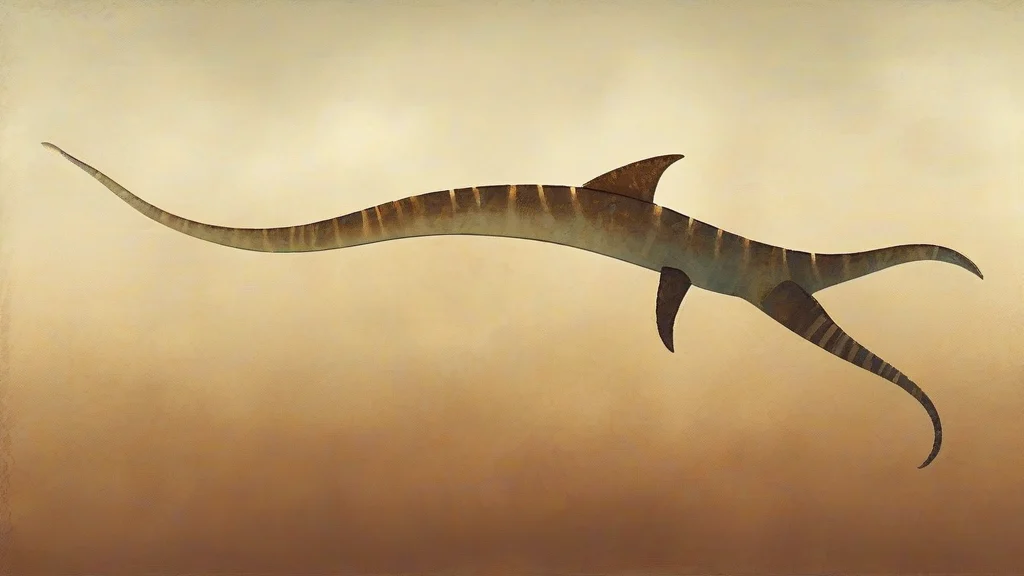
A plesiosaur is an extinct marine reptile with a long neck, a small head, and four broad, paddle-like limbs. These animals were not dinosaurs but belonged to a separate lineage of reptiles that lived during the Mesozoic, from the Late Triassic through the Cretaceous. Some forms, especially elasmosaurs, had extremely long necks and relatively small teeth, and are often reconstructed as ambush predators that swam beneath the surface. Pliosaurs were another related group, generally larger and more robust, with longer jaws and larger teeth. The name combines Greek roots associated with “near” or “full” and “lizard,” reflecting the older scientific view of their body shape. Although popular culture often portrays plesiosaurs as dangerous, serpent-like sea monsters, paleontology describes real animals adapted to life in the ocean. Their fossils are especially valuable for reconstructing ancient marine ecosystems and the evolution of reptiles.
nounA plesiosaur is an extinct group of marine reptiles characterized by a long neck, a relatively small head, and four paddle-like limbs. Plesiosaurs lived from the Late Triassic to the end of the Cretaceous, with the best-known examples including the elasmosaur and the pliosaur.
- Any member of an extinct order of long-necked marine reptiles, including animals such as elasmosaurs and pliosaurs.
"The museum display showed the long neck and paddle-like limbs of a reconstructed plesiosaur."
"Scientists discovered new plesiosaur fossils along the coast."
"The documentary used a reconstruction to explore how the plesiosaur may have moved through the water."
The standard plural is formed by adding -s.
"Fossilized plesiosaurs have been found in several parts of the world."
With a long neck, small head, and four flippers, the plesiosaur was the marine reptile equivalent of a medieval dragon—though, remarkably, it really existed.
Reviewed by Deb Chak, Editor. AI-assisted content curated by RJS Tech Solutions LLP.
Where does plesiosaur come from?
The word comes from Greek plēsios, meaning “near” or “full,” and sauros, meaning “lizard.” It was formed in the nineteenth century as a scientific name for a group of fossil marine reptiles whose long necks and paddle-like limbs seemed unusual compared with more familiar reptiles. The older sense of the root in “near” is also reflected in related scientific terminology, while sauros connects the name with the broader Greek naming tradition for reptiles and dinosaurs.
Related word forms
How plesiosaur is actually used
The term is normally used in paleontology and natural-history contexts. It is sometimes loosely applied to any extinct long-necked marine reptile, but more precise classifications distinguish plesiosaurs and their close relatives, such as pliosaurs.
Easily confused with plesiosaur
Plesiosaurs were marine reptiles, not dinosaurs; dinosaurs belonged to a different branch of the reptile family tree.
Plesiosaur is the usual noun for the extinct animal, while plesiosaurian is more commonly used as an adjective describing it or its fossils.