
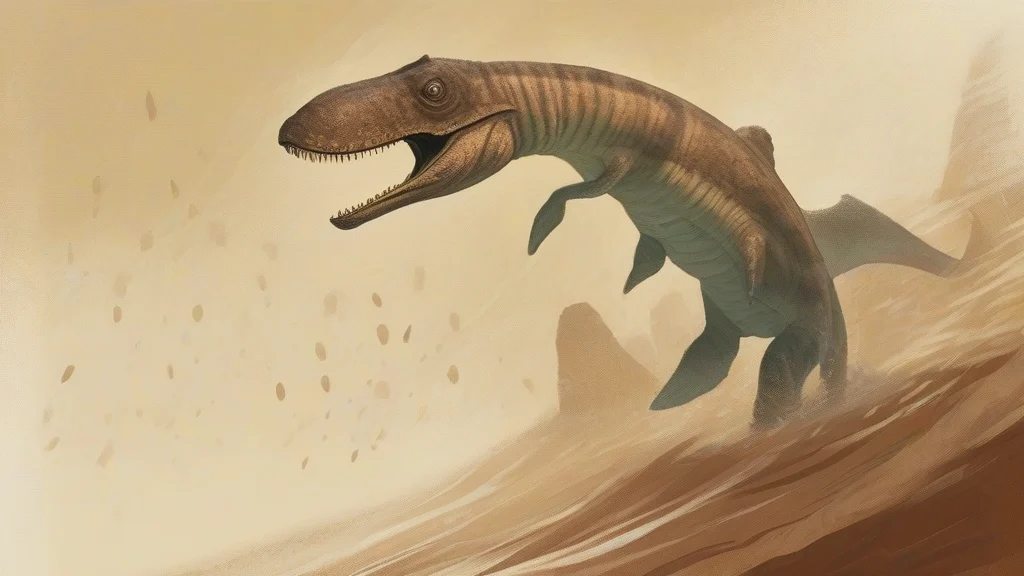
What does plesiosaurian mean?
Plesiosaurian describes an extinct type of marine reptile belonging to the plesiosaurs, a successful group that lived from the Late Triassic to the end of the Cretaceous Period. The best-known plesiosaurs had long necks, relatively small heads, broad bodies, and four paddle-like limbs, although the group also included shorter-necked forms. The term is used particularly in palaeontology for fossils, body structures, and evolutionary relationships, as in “plesiosaurian skull” or “plesiosaurian remains.” As a noun, a plesiosaurian means an individual member of the group, though modern speakers are more likely to use the shorter and more familiar term “plesiosaur.” The word is especially memorable because plesiosaurs have become enduring icons of prehistoric marine life, often depicted with an elongated, serpentine neck. Their exact relationship to modern birds remains debated, but their resemblance to one another is a striking feature of the fossil record.
Relating to, characteristic of, or belonging to the plesiosaurs, an extinct group of marine reptiles.
"The museum display included the reconstructed skeleton of a large plesiosaurian reptile."
Chiefly used in palaeontological and scientific contexts.
An individual member of the plesiosaurs, an extinct group of long-bodied marine reptiles.
"The plesiosaurian was reconstructed from several incomplete fossil bones."
Usually encountered in specialist writing; “plesiosaur” is the more common modern noun.
The plural applies to the rare noun sense and denotes multiple individual plesiosaurs.
"Several plesiosaurians are represented in the fossil gallery."
The plesiosaurian became one of paleontology's most recognizable prehistoric animals, with its serpentine neck and paddle-shaped limbs inspiring images of creatures that still haunt the imagination.
Reviewed by Deb Chak, Editor. AI-assisted content curated by RJS Tech Solutions LLP.
Where does plesiosaurian come from?
The word ultimately comes from Greek plēsios, meaning “near” or “close to,” and sauros, meaning “lizard.” The taxonomic name Plesiosaurus was created in the nineteenth century for a fossil reptile then interpreted as resembling a lizard, and the combining form subsequently developed into English “plesiosaur.” The suffix “-ian” forms the adjective “plesiosaurian” and can also be used to refer to an individual member of the group.
Related word forms
How plesiosaurian is actually used
This is primarily a specialist term used in palaeontology, palaeobiology, and museum or fossil descriptions. It is not normally used as a general term for a long-necked prehistoric animal, and its use as a noun is less common than its adjectival use.
Easily confused with plesiosaurian
A plesiosaur is an individual animal, whereas plesiosaurian is an adjective describing such an animal or the broader group to which it belongs.