
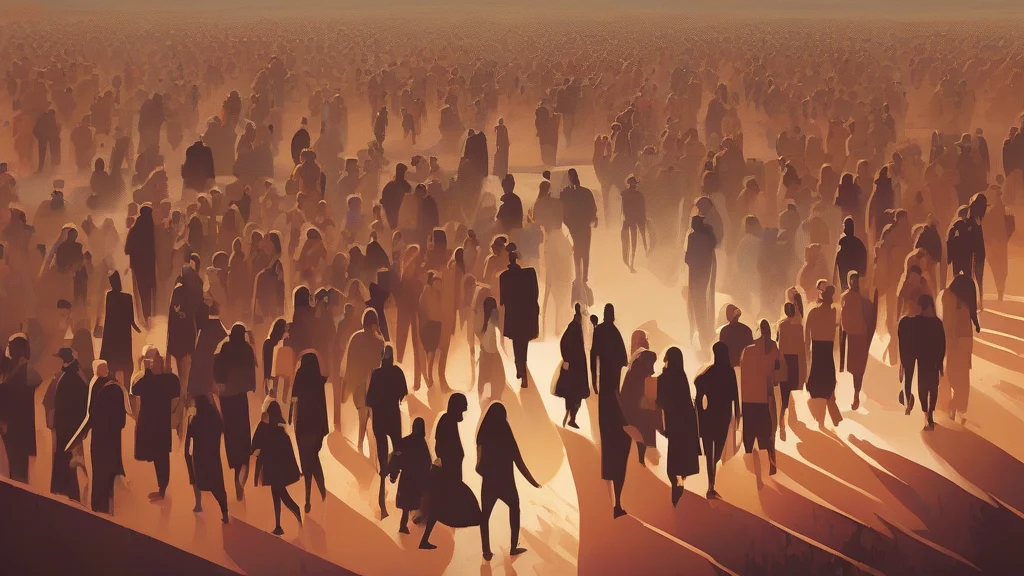
What does population mean?
Population is the number and collective body of people or organisms living in a particular place, region, habitat, or social group. It may refer simply to a locality’s inhabitants, as in “the population of the city,” or to a larger demographic group defined by age, occupation, nationality, or another characteristic. In biology and ecology, the same term describes the organisms occupying a habitat or occurring in an area. As a verb, population means to fill or supply a place with people, animals, or other inhabitants, though this use is less common than the noun. The word is especially useful in statistics, public policy, planning, environmental science, and history, where changes in the size or characteristics of a population can have significant social and economic consequences.
The inhabitants of a particular area, or the total number of people or organisms living there.
"The census recorded a population of 50,000 in the district."
In demographic and statistical contexts, population often means the number of inhabitants; in biological contexts, it can refer to organisms of one or more species sharing a habitat.
To supply a place or system with people, animals, or other organisms; to fill an area with inhabitants.
"The new housing development was populated by families from across the region."
This use is formal and relatively uncommon in everyday conversation. It is often transitive and may imply filling a space with people or organisms.
Used when referring to separate demographic, biological, or geographic groups.
"The populations of migrating birds have declined in recent years."
A population can describe not only people in a city, but also wolves in a forest or bacteria in a culture.
Reviewed by Deb Chak, Editor. AI-assisted content curated by RJS Tech Solutions LLP.
Etymology of population
The word comes through Old French from Latin populatio, a noun derived from populare, “to fill with people,” and ultimately from populus, meaning “people” or “a multitude.” The same Latin root underlies popular, populous, and populate. Its historical sense of “a multitude of people” developed into the modern meanings for inhabitants, demographic groups, and the organisms inhabiting a region.
Related word forms
How population is actually used
The noun is commonly used for both a number and the people or organisms counted. In demographic contexts, it usually refers to people; in biology and ecology, it can refer to other organisms. The verb is less common in everyday speech and often has a formal or technical tone.
Easily confused with population
Population can mean the number or total of people in a place, while populace usually emphasizes the people themselves as a social group.