
What does porcupine mean?
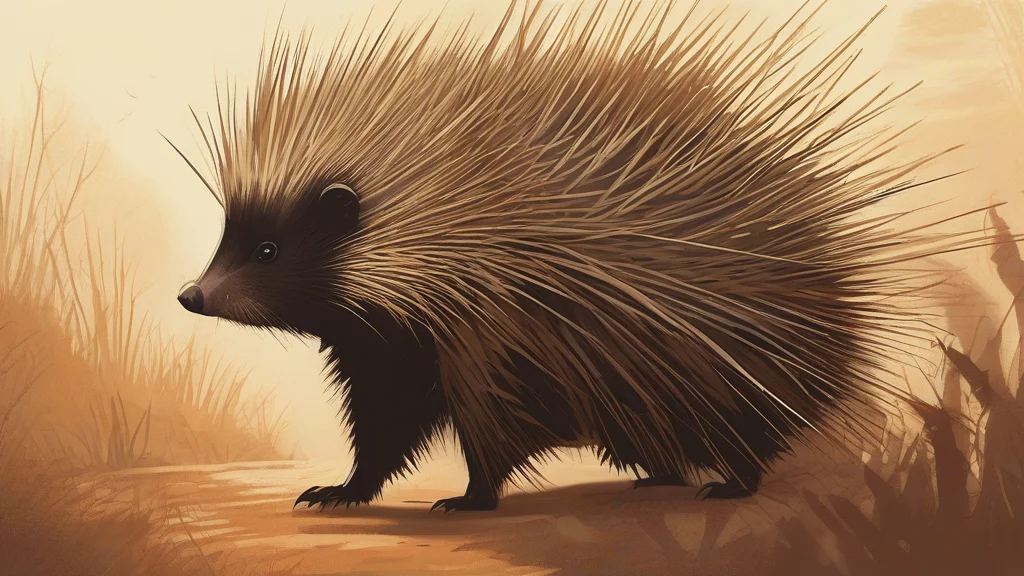
A porcupine is a large, slow-moving rodent whose body is covered with sharp, stiff quills. When threatened, it raises its quills, making itself difficult or dangerous to attack; some species can also use them defensively by thrusting or flinging them. Porcupines are found in Africa, Asia, and the Americas, although American porcupines belong to a distinct family and include species such as the North American porcupine. The word is also used figuratively for people who respond defensively or bristle with hostility. In ordinary conversation, the animal's distinctive coat is usually the central association. Its name reflects the old idea of a “pig with spines,” and its unfamiliar appearance has made it a familiar subject in descriptions of wildlife, natural defenses, and prickly personalities.
nounA large rodent covered with sharp, stiff quills that are raised as a defense when threatened. Porcupines occur in Africa, Asia, and the Americas, though the American species are very different from their Old World relatives.
- Any of various large rodents, found in Africa, Asia, and the Americas, that have bodies covered with sharp, stiff quills.
- By extension, a person or animal described as bristling, defensive, or difficult to approach.
"The porcupine backed away, raising its quills as the dog approached."
"A porcupine waddled across the trail, its quills held flat against its back."
"His comments drew a porcupine-like response from the increasingly defensive committee."
"The old North American porcupine is a skilled climber despite its heavy body."
The standard plural is porcupines, with the ending pronounced /-ɪnz/.
"Several porcupines were seen foraging near the forest edge."
A porcupine's defensive coat can contain thousands of quills, but its most famous relatives are not actually porcupines.
Reviewed by Deb Chak, Editor. AI-assisted content curated by RJS Tech Solutions LLP.
Etymology of porcupine
The word comes through Old French porc-epine, literally “porcine spine” or “pig with spines.” Its elements are Latin porcus, meaning “pig,” and spina, meaning “thorn” or “spine.” The form reflects the traditional association of the Old World porcupines with pigs because of their stocky build, snout, and rooting behavior, while the modern American porcupines are more closely related to porcupines' New World rodent relatives than to true pigs.
How porcupine is actually used
In British English, the initial r is usually not pronounced in the standard everyday pronunciation. The figurative use is relatively informal and compares someone's defensive attitude or appearance to that of the animal.
Easily confused with porcupine
A porcupine is a large rodent with long quills, whereas a hedgehog is a much smaller mammal with short spines.