
What does pram mean?
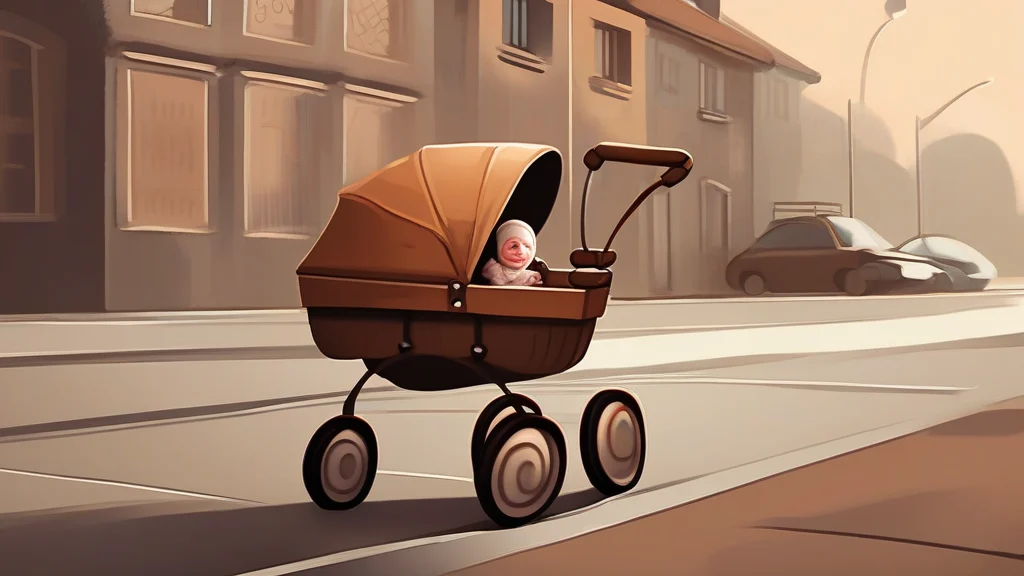
A pram is a wheeled vehicle used to carry a baby or young child. It is particularly associated with British and Irish English and is most often pushed by an adult walking along behind it, traditionally with a protective hood over the child. The word is a familiar everyday term rather than a specialized or formal one, and it has no direct standard antonym. In British usage, “buggy” and “pushchair” may sometimes overlap with it, although “pram” traditionally suggests a carriage with four wheels rather than a light folding chair. In American English, “stroller” is generally the most natural equivalent. “Pram” is also noteworthy linguistically: it began as a shortened form of “perambulator,” an elaborate Victorian term that made an ordinary household object sound as though it belonged to a formal procession.
nounA small wheeled conveyance for carrying a baby or young child, traditionally with a hood and pushed by a person walking behind it.
- A small wheeled conveyance for carrying a baby or young child, traditionally with a hood and pushed by a person walking behind it.
"She pushed the pram along the tree-lined path while the children slept."
"The pram was parked outside the café."
"He folded the pram and carried it onto the train."
The regular plural is used when referring to multiple baby carriages.
"The prams were lined up beside the school entrance."
The familiar British word began as a shortening of the much grander-sounding “perambulator.”
Reviewed by Deb Chak, Editor. AI-assisted content curated by RJS Tech Solutions LLP.
Where does pram come from?
The word “pram” originated in the late 19th century as a shortening of “perambulator,” a term then used for a baby carriage. “Perambulator” had itself been coined from the Latin verb “perambulare,” meaning “to walk about,” by analogy with the older use of “perambulator” for a person who wandered or strolled. The shortened form “pram” became established in British English and later spread to other varieties, while “perambulate” and its derivatives retained the original sense of walking.
How pram is actually used
In British and Irish English, “pram” is a standard, neutral term. It most commonly denotes a four-wheeled baby carriage, though it may also be used more broadly for a pushchair. The word is uncommon in American English, where “stroller” or “baby carriage” is preferred.
Easily confused with pram
In British English, “buggy” is often used interchangeably with “pram,” although it can also refer to other light, wheeled baby carriers.