
What does pronator mean?
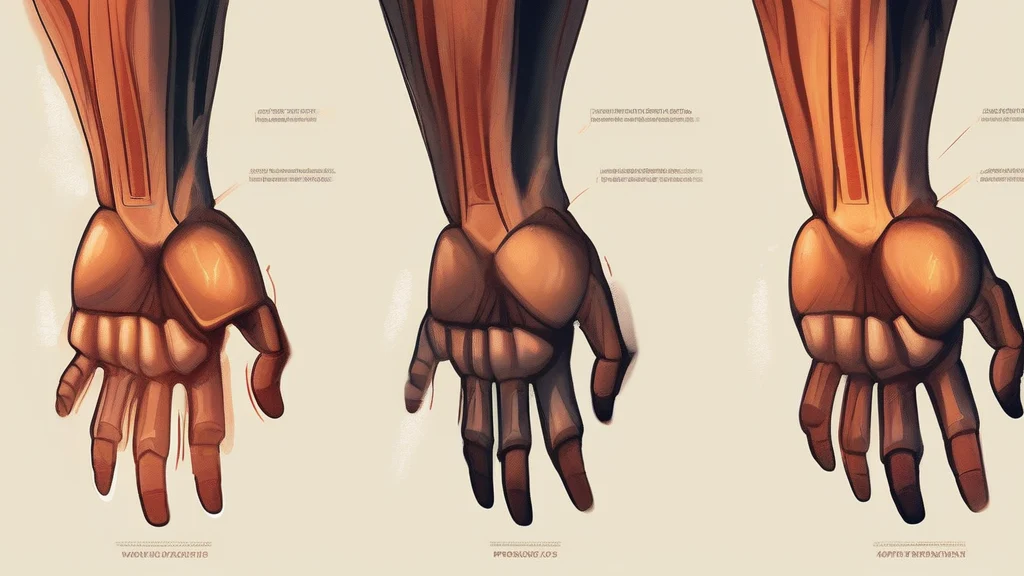
A pronator is a muscle in the forearm that turns the hand so that the palm faces downward or backward. The two principal pronator muscles are the pronator teres, which lies across the elbow and helps with forceful rotation, and the pronator quadratus, a deeper muscle nearer the wrist. Their action is opposite to that of the supinator muscles, which turn the palm upward or forward. Pronators are important in everyday movements such as placing a hand on a table, typing, turning a doorknob, or using a keyboard. In medicine, the term also appears in pronator syndrome, a condition involving compression of the median nerve in the forearm. Although the word is used broadly in anatomy, it is specialized rather than part of ordinary general vocabulary.
nounA muscle of the forearm that rotates the hand and forearm so that the palm faces downward or backward. The main pronator muscles are the pronator teres and pronator quadratus.
- Any muscle that pronates the forearm or hand, especially the pronator teres or pronator quadratus.
"The pronator teres helps rotate the forearm and pronate the hand."
"The pronator muscles contract as the athlete turns the palm downward."
"Compression of the median nerve near the pronator teres can cause pronator syndrome."
The plural is used when referring to multiple forearm muscles or to the pronator muscles collectively.
"The pronators rotate the forearm and are commonly discussed in the context of pronator syndrome."
Pronators are the forearm muscles that turn the palm down; their counterpart, the supinator, turns it up.
Reviewed by Deb Chak, Editor. AI-assisted content curated by RJS Tech Solutions LLP.
Where does pronator come from?
The word comes from Latin pronator, a noun meaning “one that pronates,” formed from pronare, “to pronate” or “to bend forward,” with the agentive suffix -tor. The same Latin root appears in English words such as pronate and pronation. The anatomical sense developed from the general idea of turning the hand or forearm toward a downward or forward-facing position.
Related word forms
How pronator is actually used
In anatomy and clinical usage, pronator usually refers to a forearm muscle. The term is technical and is most often encountered in anatomical descriptions, medical literature, and discussions of pronator syndrome.
Easily confused with pronator
A pronator rotates the palm downward or backward, whereas a supinator rotates it upward or forward.