
What does punch mean?
Punch is a versatile English word with several firmly established meanings. Its most common use refers to a forceful blow, especially one delivered with the fist in boxing or a physical confrontation; as a verb, it means to strike someone in this way. It can also mean a fruit-based drink, usually prepared with juice and sometimes sugar, spices, rum, or other ingredients. In informal British and American English, "a punch" may additionally mean a lively party or social gathering. In technical and everyday contexts, the verb can describe making a hole or mark, or perforating a card or ticket. The word is often vivid and energetic: it suggests force, impact, or liveliness. In the idiom "to punch above one's weight," it describes achieving more than would normally be expected. Thus, punch can move easily from physical action to drink, entertainment, and metaphor.
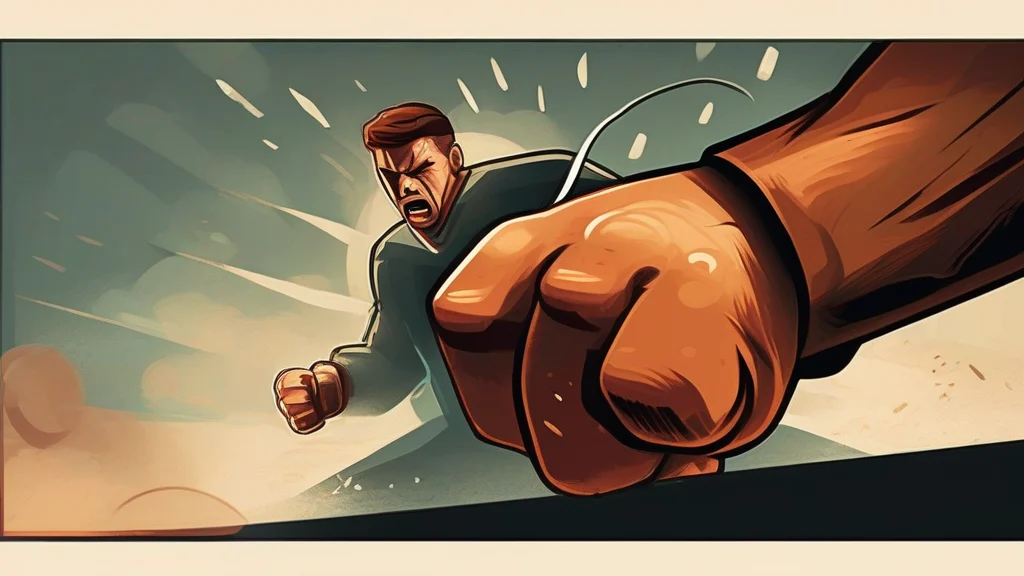
A punch is a forceful blow made with the fist or another object. It can also refer to a fruit-based drink or, informally, a lively party.
"The crowd cheered after the champion landed a decisive punch."
To punch means to strike someone or something forcefully with the fist or another object. It can also mean to make a hole or mark by pressing with a tool, or to perforate a card or ticket.
"The technician punched a hole in the metal plate."
The verb can describe both deliberate blows and the action of perforating or marking material. In contexts involving a punch card or punched ticket, the word refers to forming or recording a perforation.
The plural is used for individual blows and, in some contexts, for servings or instances of the drink.
"The boxer landed two powerful punches in the final round."
Punch is a linguistic multitasker: it can be a blow, a drink, a party, or the act of making a hole—and the phrase "punch above one's weight" even turns striking into a metaphor for exceeding expectations.
Reviewed by Deb Chak, Editor. AI-assisted content curated by RJS Tech Solutions LLP.
Where does punch come from?
The striking sense of punch developed in Middle English through Old French poncher, ultimately from Latin punicare, meaning to pierce, which is related to Latin pungere, "to prick or pierce." The same Latin root lies behind words such as punctual, punctuate, and punctuation. The drink sense came through Hindi pānch, meaning "five," a reference associated with the traditional mixture of five principal ingredients.
Related word forms
How punch is actually used
The sense meaning a forceful blow is common in general English and is strongly associated with boxing and physical conflict. As a drink, punch may be alcoholic or nonalcoholic. The sense meaning a party is informal and somewhat old-fashioned, while the phrase "punch above one's weight" is an idiomatic metaphor meaning to perform better than expected.
Easily confused with punch
A punch is a blow or the action of striking, whereas a puncture is the hole made by a sharp point or pointed tool.