
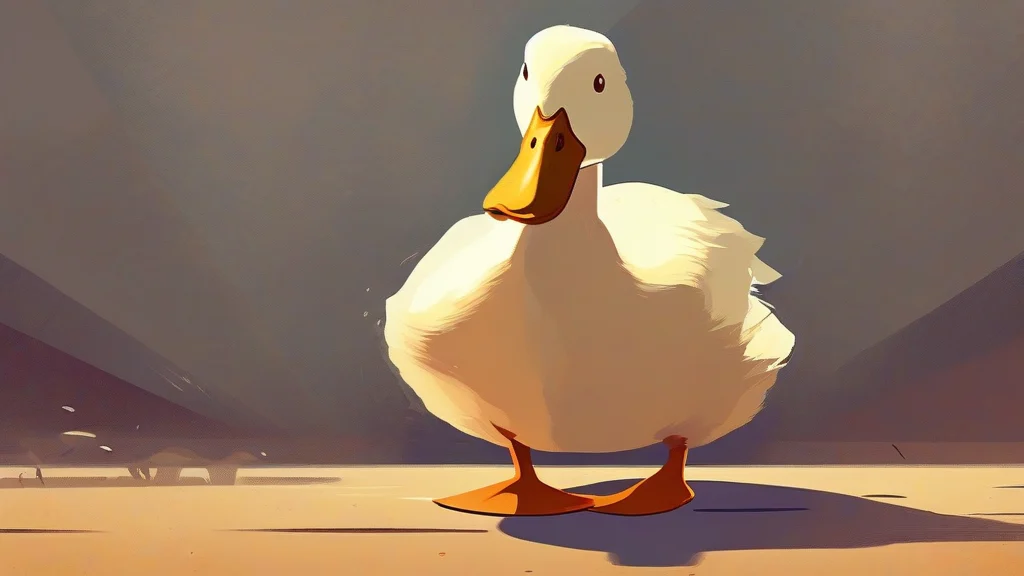
What does quacked mean?
“Quacked” is the past tense of “quack” and has two connected uses. Literally, it describes the short, harsh sound made by a duck or similar bird. Figuratively, it can describe someone speaking in a loud, nasal, comical, or mocking way, as in a person who “quacked” for attention or an audience that “quacked” with laughter. The word is recognizable and often humorous, making it useful in descriptions of both animal sounds and conspicuously noisy behaviour. In ordinary narration, it normally implies a completed action: the bird “quacked,” the speaker “quacked,” or the audience “quacked.” Its figurative use can be affectionate or teasing rather than seriously insulting, although context determines whether the sound is being presented as comic, foolish, or abrasive. Because it is a regular past-tense verb, it pairs with the present form “quacks” and the progressive form “quacking.”
verbThe past-tense form of quack, used to describe the harsh, quacking sound made by a duck or, figuratively, to describe speaking in a loud, harsh, or mocking manner.
- Made the characteristic harsh sound of a duck.
- Spoke or called out in a loud, harsh, or mocking voice.
"The duck quacked loudly as she crossed the pond."
"The duck quacked and flew toward the reeds."
"He quacked for help when the car slid into the ditch."
"The audience quacked with laughter at the comedian's impression."
One honk, one instant: “quacked” is the word for the unmistakable sound that made the duck famous.
Reviewed by Deb Chak, Editor. AI-assisted content curated by RJS Tech Solutions LLP.
Where does quacked come from?
The word comes from the Middle English verb “quaken,” which referred to the cry of a duck and had a sound related to the modern word “quack.” Its original sense was the characteristic call of a duck. The figurative use for noisy, absurd, or pretentious speech developed later by analogy with the bird's call. The precise details of that development are not clear enough to state with certainty.
Related word forms
How quacked is actually used
In the literal sense, it is used for the sound of a duck or a similar waterfowl. Figuratively, it can describe loud, harsh, or comic speech, often with a mocking or absurd tone.
Easily confused with quacked
“Quack” is the base verb, noun, and adjective, while “quacked” is specifically the past tense of the verb.