
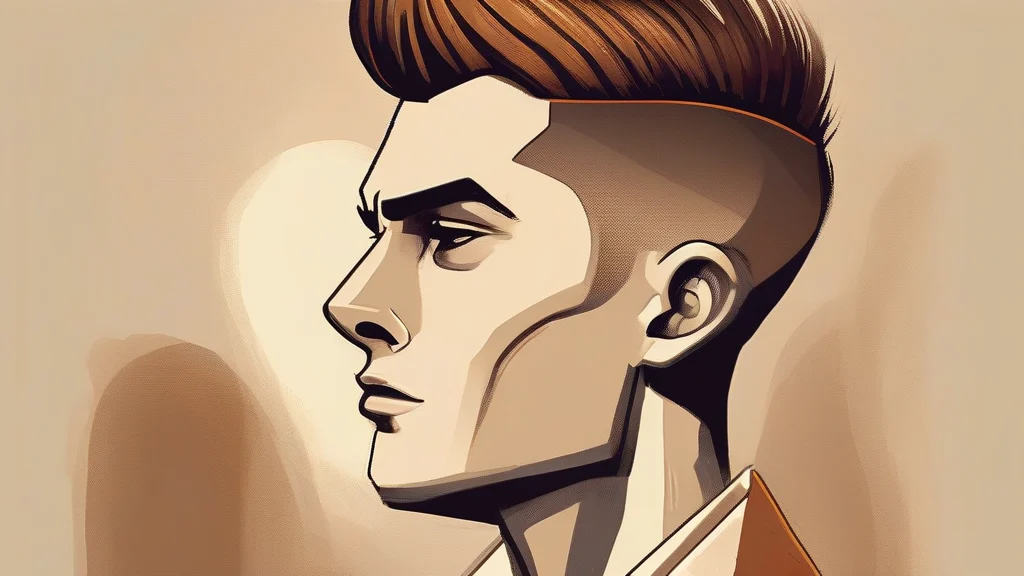
What does quiff mean?
A quiff is a tuft or crest of hair, particularly one that rises or sweeps forward over the forehead. The word can denote the hair itself or the prominent front section of a hairstyle in which the hair is dressed upward with grease or another styling product. It is chiefly a British informal term and is particularly associated with the exaggerated hairstyles of Teddy boys in the 1950s, as well as later rockabilly and retro styles. A quiff differs from an ordinary cowlick mainly in degree and styling: both involve hair standing away from the scalp, but a quiff is usually deliberately shaped and may form a distinct crest. Because it can sound dated or distinctly British, the word often carries a nostalgic, fashionable, or slightly comic tone when used today.
A tuft or crest of hair, especially hair brushed upward or forward over the forehead; also a hairstyle featuring such a tuft.
"His blond hair was swept into a tall quiff."
Chiefly British and informal, with a strong association with 1950s Teddy boy fashion and modern retro or rockabilly styling.
To brush or arrange the hair into a quiff.
"He quiffed his hair in the mirror before school."
Chiefly British and informal; less common than the noun.
Used for separate tufts or hairstyles of the hair; usually plural in the sense of hairstyles.
"The barber gave his two sons sharp silver quiffs."
The quiff became an icon of 1950s British youth culture, when Teddy boys swept their hair into glossy, carefully sculpted fronts.
Reviewed by Deb Chak, Editor. AI-assisted content curated by RJS Tech Solutions LLP.
Where does quiff come from?
The word appeared in early twentieth-century British English, but its precise origin is uncertain. Its familiar cultural association is with the sculpted hairstyles popular among Teddy boys in the 1950s. Although later dictionaries also record it as a verb meaning to arrange the hair in such a style, no certain cognates or established relatives are known.
Related word forms
How quiff is actually used
Chiefly British and informal; in Britain it is especially associated with Teddy boys and rockabilly styles. In American English, the more general term is usually hair tuft, while pompadour refers to a more voluminous, swept-back hairstyle.