
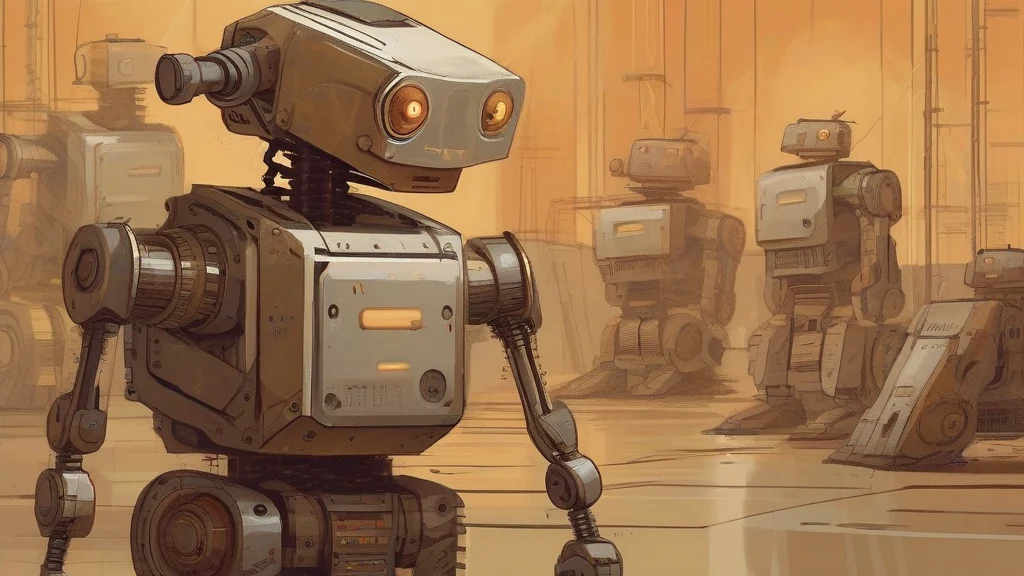
What does robot mean?
A robot is a machine that carries out tasks automatically, usually through programmed instructions, sensors, or remote control. Robots may work alongside people in factories, warehouses, laboratories, hospitals, and homes, performing jobs that require speed, precision, or endurance. The word can also describe a person who behaves in a mechanical, repetitive, or emotionally detached manner, although this figurative use can be insulting because it implies an absence of human warmth and individuality. In popular culture, robots are often portrayed as intelligent humanlike machines, but the term does not necessarily imply human appearance: many real robots are industrial arms, mobile devices, or specialized machines designed for a limited range of tasks. The word comes from the Czech “robota,” meaning compulsory or forced labor, and was introduced into English through the 1920 play “R.U.R.,” in which artificial workers revolt against their human creators.
A programmable machine capable of performing tasks automatically, often under the control of software, sensors, or an operator.
"The robotic arm placed the components on the assembly line."
The sense is neutral and technical, though fictional robots are often given humanlike appearances and personalities.
A person whose behavior is described as repetitive, inflexible, or emotionally impersonal.
"The receptionist handled each question with the efficiency of a robot."
This figurative sense is usually negative and may be offensive when directed at a person.
Use the plural “robots” for multiple machines or multiple figurative references.
"Several robots are assembling the frames in the new plant."
The word “robot” entered English from a Czech word meaning forced labor, turning an old idea of human drudgery into a modern vision of mechanical workers.
Reviewed by Deb Chak, Editor. AI-assisted content curated by RJS Tech Solutions LLP.
Where does robot come from?
The word derives from Czech “robota,” meaning forced or compulsory labor. It was popularized in English by the 1920 play “R.U.R.,” whose title abbreviates “Rossum’s Universal Robots,” a term for artificial workers. The Czech word itself is related to “robot,” meaning forced labor, a development influenced by the notion of serf labor; the English spelling “robot” became established for a machine designed to perform work.
Related word forms
How robot is actually used
Robot is standard in both British and American English. In figurative use, it can sound critical when describing a person as lacking warmth or spontaneity; the expression “robotic” is often less blunt when describing repetitive or inflexible behavior.
Easily confused with robot
A robot is a machine that performs tasks, whereas an android is conventionally a humanlike artificial being, often imagined as resembling a person.