
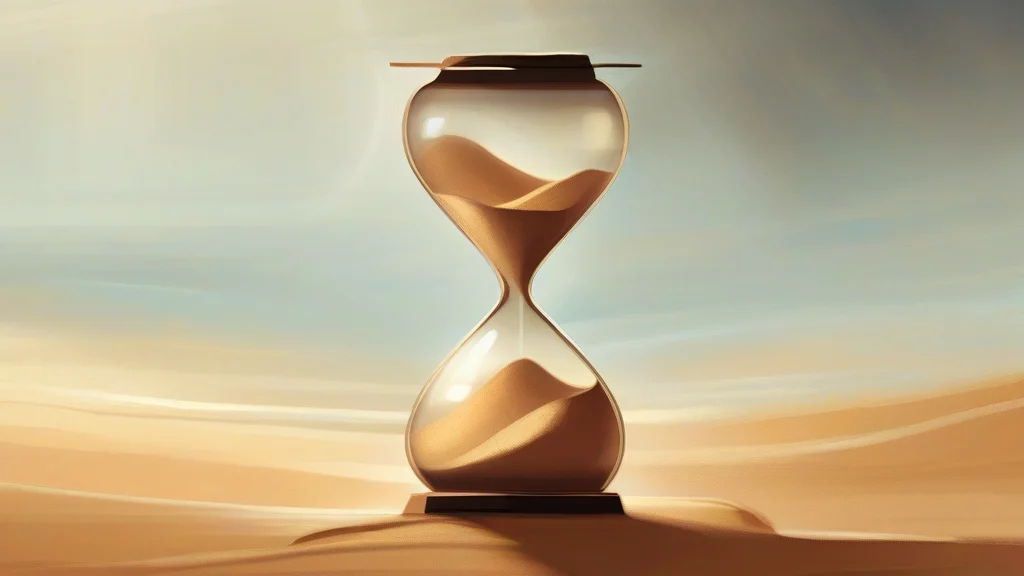
What does sandglass mean?
A sandglass is a traditional timer in which dry sand falls through a narrow opening between two glass bulbs. Its flow rate is set so that a specified quantity of sand takes a known amount of time to pass, commonly an hour or several minutes. Because the movement of the sand is visible, a sandgraph provides an immediate, tangible indication of time passing without requiring a clock or battery. Sandglasses have long been associated with ship navigation, cooking, public announcements, and formal proceedings, including courtrooms and lectures. The term is still used for decorative or traditional timers, although electronic timers are more common for everyday use. “Hourglass” frequently serves as a synonym, although an hourglass more specifically refers to a device calibrated to measure an hour or presented in the familiar hourglass shape.
nounA timer consisting of two glass bulbs joined at the neck and mounted in a frame, with dry sand trickling from the upper bulb into the lower one. The amount of sand used is calibrated to measure a stated interval of time.
- A device for measuring time using dry sand that flows between two glass bulbs.
"The sandglass on the mantelpiece showed that only five minutes remained before the next train."
"They turned the sandglass over and waited for the eggs to boil."
"The lecturer used a sandglass to remind the audience that each talk had a strict time limit."
The regular plural is “sandglasses.”
"Several sandglasses were arranged across the table."
Before batteries, a sandglass turned the passing of time into a visible stream.
Reviewed by Deb Chak, Editor. AI-assisted content curated by RJS Tech Solutions LLP.
Where does sandglass come from?
The word dates from the 17th century and was formed by combining the older words “sand” and “glass.” Both elements are transparent about the mechanism: sand passes through glass vessels shaped like two bulbs joined at their narrow ends. The related word “hourglass” developed through the same compound-forming pattern, with “hour” specifying the interval traditionally measured.
Related word forms
How sandglass is actually used
The word is formal and somewhat traditional today. In contemporary usage, “sandglass” often describes the timing device itself, while “hourglass” is common even when the measured interval is not an hour.
Easily confused with sandglass
A sandglass is the general name for a sand-filled timing device, while an hourglass specifically measures or represents an hour, although the term is often used more broadly.