
What does hourglass mean?
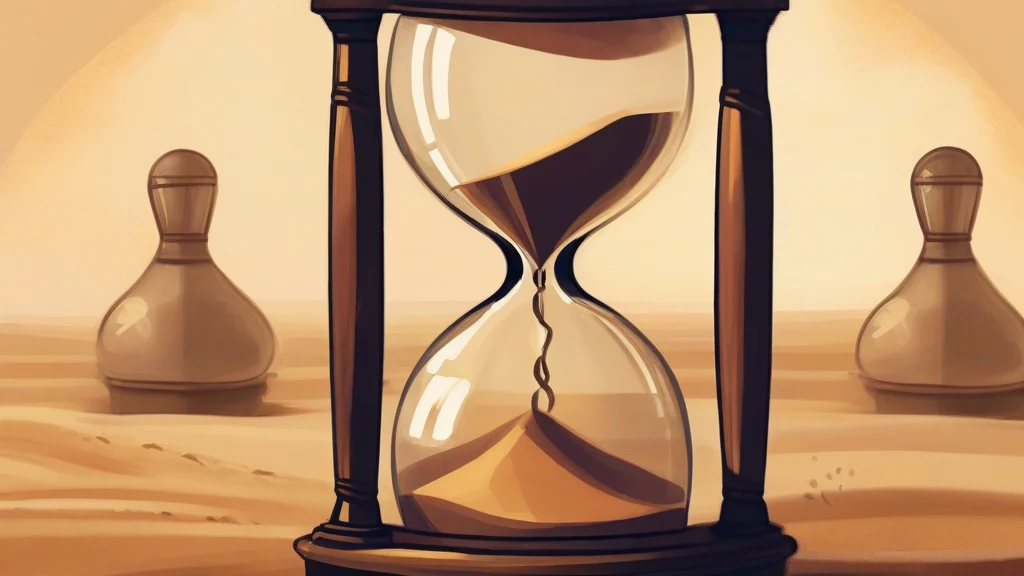
An hourglass is a device that measures time by allowing sand to fall through a narrow opening between two glass bulbs. As the sand moves, the amount remaining in the upper bulb provides a visual indication of how much time has passed. The word also describes a shape with two broad ends joined by a narrow middle, and it can figuratively suggest a limited or rapidly changing period of time. Hourglasses have long been associated with sand, learning, patience, and limited resources, so the image often carries a sense of inevitability or time slipping away. In modern usage, an hourglass may be decorative, ceremonial, or used to mark the end of a task, while the term also remains common in literary descriptions of bodily shapes and the passage of time.
nounA device made of two joined glass bulbs containing sand, used to measure time by allowing the sand to flow from one bulb to the other. By extension, the word can refer to a narrow-waisted, roughly hourglass-shaped form or to a limited period of time.
- A device with two glass bulbs joined at a narrow opening, containing sand that runs from the upper bulb to the lower one to measure time.
- A shape resembling an hourglass, especially a narrow waist between two wider ends.
- figuratively, a limited or rapidly passing period of time.
"The hourglass on the desk had run out, signaling that the interview was over."
"She turned the hourglass and began the final section of the exam."
"The marathon runner's training was shaped like an hourglass, with strong performances at the beginning and end of the race."
The plural is formed by adding -es to the singular noun.
"Several hourglasses were arranged across the table."
An hourglass turns the flow of sand into a visible countdown, making the passage of time something you can watch rather than merely read on a clock.
Reviewed by Deb Chak, Editor. AI-assisted content curated by RJS Tech Solutions LLP.
Where does hourglass come from?
The compound hourglass combines "hour," from Latin hora, meaning a period of time, with "glass," referring to the transparent material from which the timing device is traditionally made. The word developed during the early modern period as the sand timer became a familiar instrument for marking short intervals. Its components also appear in related English words connected with time and timekeeping, including "hourly," "horology," "horary," and "horometer."
Related word forms
How hourglass is actually used
The word is commonly used for both the physical sand timer and the familiar narrow-waisted shape. In figurative use, especially phrases such as "an hourglass of time," it has a literary or dramatic tone. "Sandglass" is an established alternative, while "egg timer" is more specific to a kitchen appliance.
Easily confused with hourglass
An egg timer is a kitchen device designed to time boiling eggs, while an hourglass is a sand-based instrument that measures an interval of time through the movement of sand.