
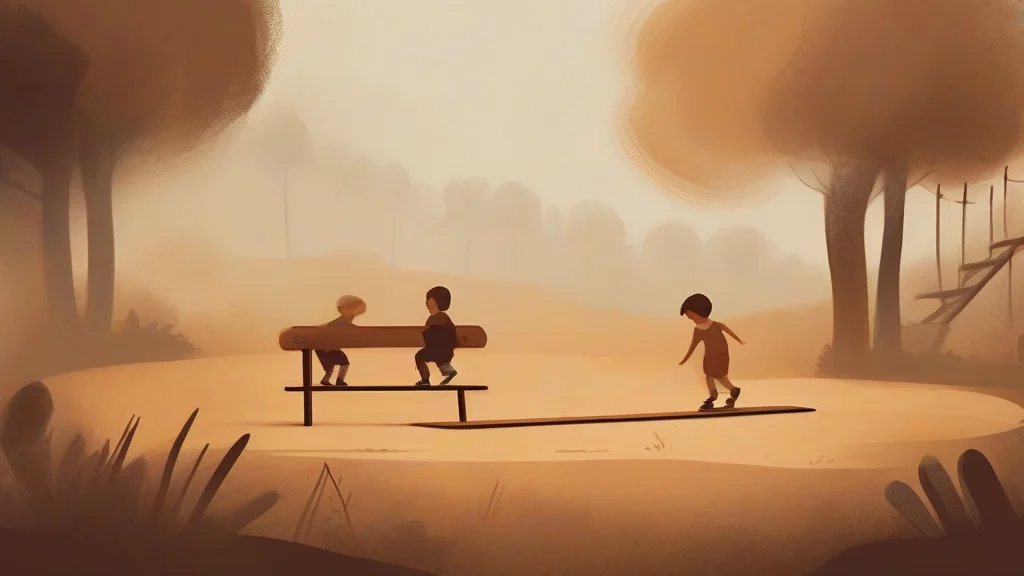
What does seesaw mean?
A seesaw is a playground device made from a long board balanced on a central support, so that one end rises while the other falls. The word can also describe any repeated movement between two opposing positions or outcomes, such as a contest in which the lead changes repeatedly. In this broader sense, seesaw suggests instability, competitiveness, or a lack of a clear advantage. As a verb, it describes something that alternates between two states or directions and is commonly used in sports reporting, politics, business, and general commentary. The term is vivid because it evokes the familiar motion of children taking turns on a playground apparatus. It is standard in both British and American English, although the related name teeter-totter is especially common in North America. Because seesaw conveys an up-and-down pattern, it is useful when the emphasis is on repeated change rather than steady progress.
A long board with a seat at each end, balanced on a central support so that it moves up and down. By extension, an alternating change between opposing positions, levels, or outcomes.
"The new law has become a political seesaw, shifting the balance of power back and forth."
The figurative noun is common in journalism and commentary.
To move or change repeatedly between two opposing positions, levels, or outcomes.
"The championship seesawed as neither team managed to establish a lasting lead."
This use is informal but widespread, particularly in sports and political reporting.
Use the plural when referring to multiple playground devices or when discussing different examples of alternating movement.
"The playground has two seesaws beside the swings."
A seesaw turns one simple principle into movement: what goes up must come down.
Reviewed by Deb Chak, Editor. AI-assisted content curated by RJS Tech Solutions LLP.
Where does seesaw come from?
The word is a compound of the familiar English words see and saw, developed in the nineteenth century for the apparatus whose movement allows one side to rise as the other descends. Its form preserves the idea of one end going up while the other goes down. The element see belongs to the same broad Germanic and Old English etymological tradition associated with words such as view, vision, perceive, and inspect.
Related word forms
How seesaw is actually used
As a verb, seesaw is informal and is especially common in journalism and commentary for describing rapid reversals. The noun is standard in both British and American English.
Easily confused with seesaw
A teeter-totter is a specific playground apparatus, while seesaw can refer both to that device and more generally to an alternating rise and fall.