
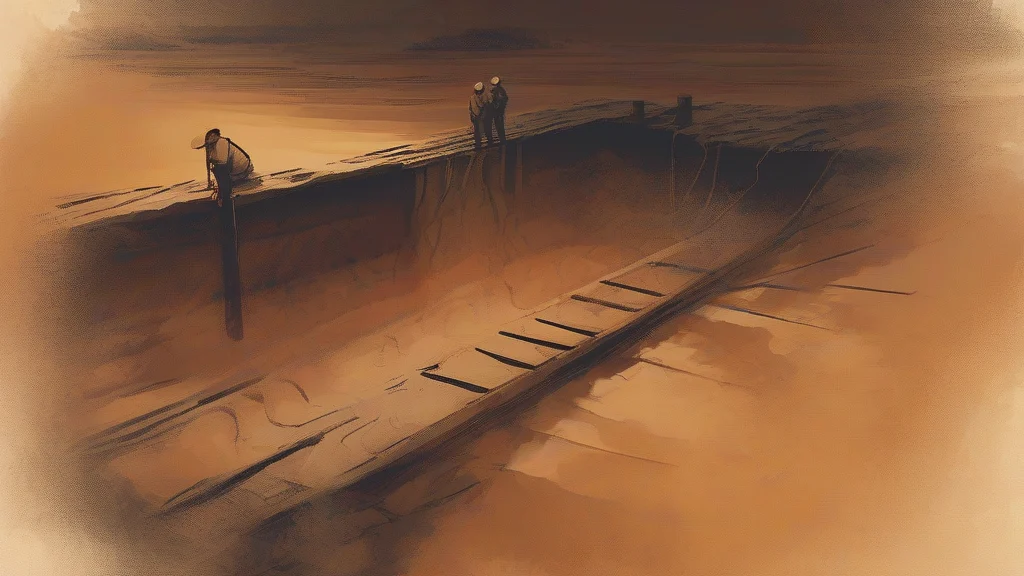
What does silted mean?
Silted describes a river, harbor, canal, or other passage that has become filled or obstructed by fine sediment. The word is especially common in descriptions of waterways whose usable depth has declined because mud and other particles have settled. As the past tense and past participle of silt, it also appears in phrases such as 'the channel silted up.' The adjective often carries an implication of neglect or natural alteration: a silted harbor is not merely dirty but functionally impaired. In geographical and environmental writing, the term can describe gradual accumulation, while in engineering and local news it usually points to the practical consequences for navigation. Silted is a precise and useful word for distinguishing an obstruction made of sediment from a blockage caused by debris, vegetation, or structural damage.
Covered, filled, or obstructed by fine sediment.
"The river port was silted, leaving vessels unable to reach the main quay."
Often used with waterways, ports, channels, and reservoirs; frequently appears in the phrase 'silted up.'
Past tense and past participle of silt: to become filled or slowed by deposited sediment.
"The shallow bay silted rapidly as the river carried sediment toward the coast."
Most often used in the passive or with 'up,' as in 'the channel was silted up.'
A river can be technically navigable and still be silted: the water may look deep while a layer of sediment makes the channel dangerously shallow.
Reviewed by Deb Chak, Editor. AI-assisted content curated by RJS Tech Solutions LLP.
Where does silted come from?
The word derives from silt, the fine sediment deposited by flowing water. The verb silt developed from the earlier sense of depositing or accumulating this material, and silted naturally came to describe places filled or obstructed by it. Silt itself is related to older forms in English and continues to preserve its connection with deposited earth and sediment.
Related word forms
How silted is actually used
In its adjectival use, silted often implies that a waterway or container has accumulated sediment. In its verbal use, it commonly appears in the passive construction 'become silted' or 'be silted up.'
Easily confused with silted
Silt is the fine sediment itself, whereas silted describes a place or passage that has been filled or obstructed by that sediment.