
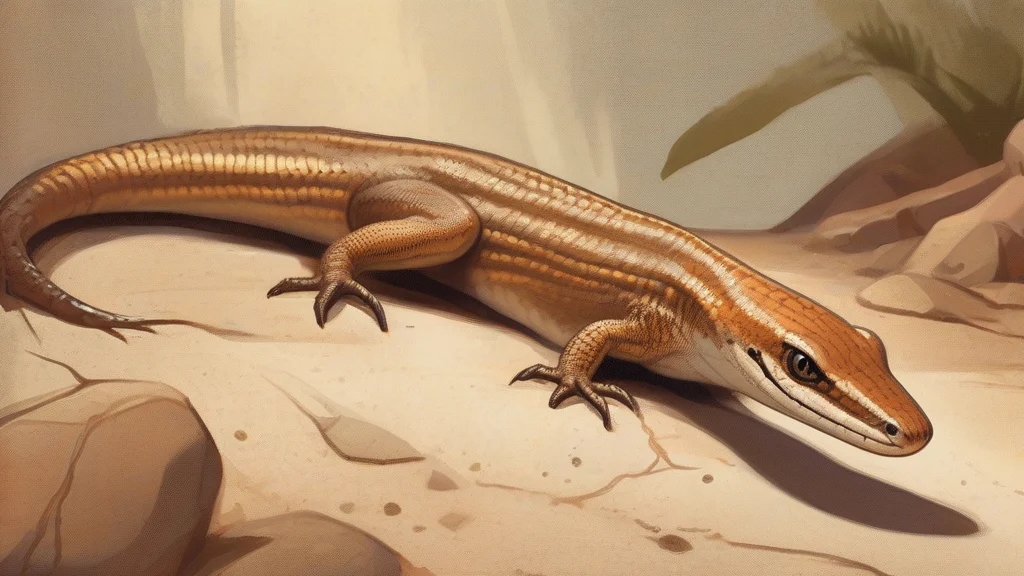
What does skink mean?
Skink most often denotes a member of the lizard family Scincidae, a diverse group that includes glossy blue-tongued skinks, small brown woodland species, and several legless burrowing forms. The word can refer to the family collectively or to an individual species, and it is especially useful when the smooth scales, reduced limbs, or burrowing habits of a lizard merit attention. As a verb, skink means to withdraw or slip away with conspicuous speed and furtiveness. This use is chiefly associated with British and Commonwealth English and is commonly seen in the phrase "skink off." The contrast between the precise zoological noun and the informal, slightly playful verb gives skink an unusual range. Although the two senses belong to different parts of speech, both convey quick movement: a literal skink darts into cover, while a person who skinks off slips away without attracting attention.
A lizard belonging to the family Scincidae, often with smooth, shiny scales and short, reduced, or absent limbs.
"The naturalist identified the small brown animal as a skink."
The term is used internationally and may refer either to an individual lizard or, collectively, to members of the family Scincidae.
To move or slip away quickly and furtively.
"The witness skinked off before anyone could ask another question."
Chiefly British and Commonwealth English; the construction "skink off" is particularly common.
The standard plural is "skinks." The unmodified singular can also be used collectively for the family.
"Several skinks sheltered beneath the garden stones."
Some skinks have no legs at all, making this lizard family a surprising example of how evolution can transform an entire body plan.
Reviewed by Deb Chak, Editor. AI-assisted content curated by RJS Tech Solutions LLP.
Etymology of skink
The English noun is recorded from the 17th century and belongs to a chain of borrowing through Latin scincus, ultimately from Ancient Greek skínkos, an ancient term for a kind of lizard; the further origin of the Greek word is uncertain. The verb developed in British usage, particularly in Scotland, during the 19th century with the sense of moving or escaping quickly and stealthily. Related English forms such as scincid, scincoid, and scinciform continue to reflect the same Latin and Greek root.
Related word forms
How skink is actually used
As a noun, skink is standard and international in zoological and general usage. As a verb, it is informal and especially associated with British and Commonwealth English; "skink off" is its commonest construction.
Easily confused with skink
Skink is a type of lizard or a verb meaning to slip away furtively, whereas skint is chiefly British slang for lacking money or resources.