
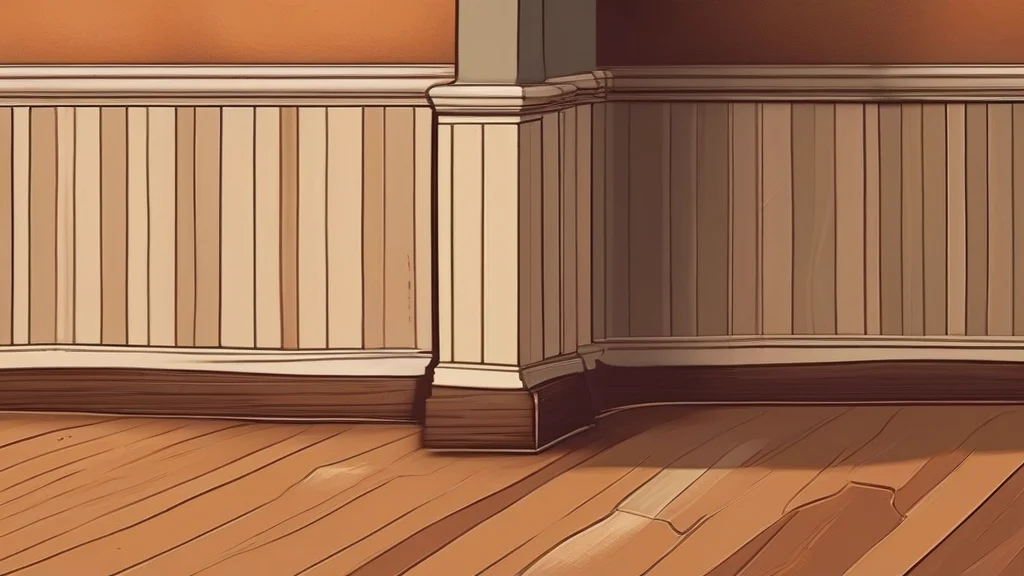
What does skirting mean?
Skirting has two principal modern uses. As a noun, it denotes the narrow strip of wood, vinyl, metal, or other material placed along the bottom of a wall, normally to cover the junction between the wall and floor. It can also refer more generally to a decorative border attached to an object. In British English, the material is frequently called a “skirting board,” while “skirting” may itself mean the whole board. As a verb, skirting means moving around the edge or boundary of something and, figuratively, avoiding or evading a topic or obligation. Phrases such as “skirting around the issue” suggest evasiveness and are commonly used in political, legal, and business reporting. The word is useful because it describes both a practical architectural feature and a recognizable strategy of avoiding direct engagement with a difficult subject.
A narrow strip of wood, vinyl, or similar material fixed along the bottom of a wall, especially to cover the junction between wall and floor; more generally, a border or edging.
"They painted the walls but left the existing skirting untouched."
In British English, “skirting” often refers to the complete board fitted against a wall. The plural “skirtings” is uncommon.
To move or pass around the edge or boundary of something; to avoid or evade a topic, issue, responsibility, or obstacle.
"The report skirts the question of whether the policy will be affordable."
The figurative sense often carries a critical connotation, particularly when combined with “around.”
The plural is uncommon; skirting is normally treated as a singular or mass noun.
"The supplier offered several types of timber skirtings."
Skirting boards hide the seam where a wall meets the floor, but skirting an issue leaves the central problem just as visible.
Reviewed by Deb Chak, Editor. AI-assisted content curated by RJS Tech Solutions LLP.
Where does skirting come from?
The word belongs to the English family of “skirt,” which comes through Middle English from Old Norse skýrt, a garment, ultimately related to a Germanic root associated with clothing and covering. “Short” and “shirt” are also cognates within that family. The verb use of “skirting” developed from the idea of moving or passing around something, while the noun use for a bordering material developed from the older sense of an edge or covering strip.
Related word forms
How skirting is actually used
As a noun, skirting is common in British English and is also used in North American English, especially in construction and interior design. In British usage, “skirting” may refer to the strip itself or to a skirting board. As a verb, “skirting around” is often mildly critical, suggesting avoidance without confronting the issue directly.