
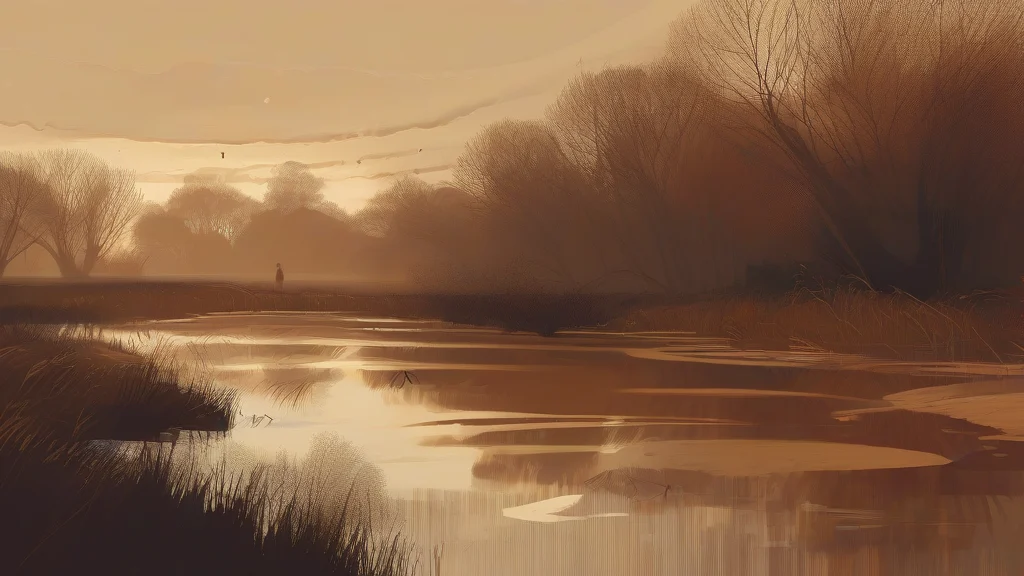
What does slough mean?
Slough has several connected but distinct meanings. As a noun, it can refer to soft, muddy ground, a marsh or swamp, a figurative condition marked by vice, degradation, or despair, or the old skin shed by a snake. As a verb, slough means to cast off an outer layer, particularly skin, and by extension to discard something unwanted or troublesome. The word is useful because it brings together images of mire, transformation, and release: a slough may be a difficult physical obstacle, while sloughing off a burden can mean shedding it. The muddy-place pronunciation is especially familiar in North American English, where /sluː/ is common, while the skin-related sense is typically pronounced /slaʊ/. In literary contexts, phrases such as “a slough of despondency” describe a deep or hopeless emotional state.
A soft, muddy area of ground; a marsh or swamp; a figurative state of moral degradation or despair; or the skin cast off by a snake.
"The village road was transformed into a slough by the heavy rain."
The figurative noun is common in formal and literary writing, especially in expressions such as “a slough of vice” or “a slough of despondency.”
To cast off or shed an outer layer, especially skin; figuratively, to discard or reject something undesirable.
"The snake sloughs its skin as it grows."
The verb is relatively formal in its literal and figurative uses and may be especially associated with snakes or other animals that shed their skin.
The plural sloughs is used for separate muddy places or figurative states and for individual cast-off skins.
"Several sloughs of mud blocked the trail."
A slough can be a literal stretch of mud, a figurative state of moral or emotional decay, and even the skin a snake leaves behind.
Reviewed by Deb Chak, Editor. AI-assisted content curated by RJS Tech Solutions LLP.
Where does slough come from?
The muddy-ground sense of slough comes from Old English slōh, meaning a pool or place of mud. The skin-shedding sense developed through Middle English usage associated with the related animal sense of a shed skin, while figurative meanings such as moral degradation and the casting off of a burden developed by extension.
Related word forms
How slough is actually used
The pronunciation /slaʊ/ is the most familiar for the skin-shedding sense. The variant /sluː/ is especially associated with the muddy-place sense in North American usage. Figurative uses such as “a slough of despondency” are formal or literary.
Easily confused with slough
Slough can mean muddy ground or a shed skin, whereas a sloe is the small dark-purple fruit of the blackthorn.