
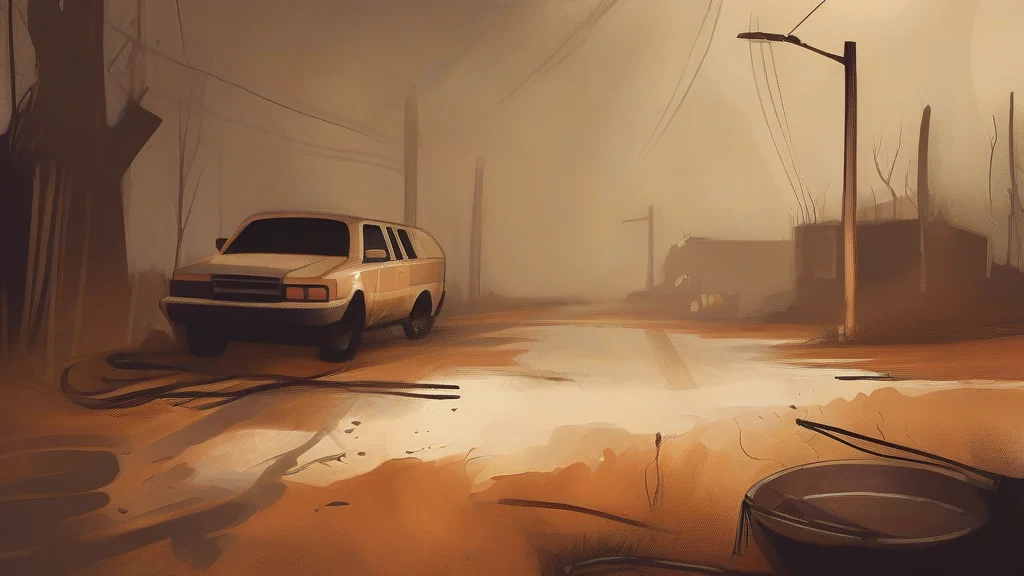
What does smudginess mean?
Smudginess is the state or quality of being smudgy: softly blurred, smeared, or deprived of clear outlines. It most often describes the appearance of an image, print, or mark whose details have become indistinct, as though ink has spread or a photograph has lost contrast. The word can also be used metaphorically for writing or speech that is vague, imprecise, or lacking in definition. In this sense, smudginess suggests not simply obscurity caused by difficult subject matter, but a loss of clarity and sharpness. It is more closely associated with literary and descriptive language than with everyday technical vocabulary. While “blur” or “blurriness” may describe the visible effect in a photograph, “smudginess” can extend beyond visual appearance to any blurred or ill-defined quality. The term is relatively uncommon, but it is useful when emphasizing the gradual fading of detail or the deliberate softening of a line.
nounThe quality of being smudgy, especially a lack of sharpness, clarity, or definition in an image, mark, or written expression.
- The quality or condition of being smudgy, lacking sharpness, clarity, or definition.
"The old photograph had faded to a soft smudginess that obscured every facial detail."
"Smudginess in the photograph made the distant buildings impossible to distinguish."
"She tried to reduce the smudginess of her argument without making it sound less forceful."
Rare; the uncountable form “smudginess” is much more common.
"The lecturer discussed the various smudginesses of the faded manuscripts."
Smudginess is what remains when a sharp image or precise word is reduced to a blurred trace.
Reviewed by Deb Chak, Editor. AI-assisted content curated by RJS Tech Solutions LLP.
Where does smudginess come from?
“Smudginess” was formed by adding the suffix “-ness,” meaning the state or quality of being, to “smudge.” The word “smudge” is attested from the early 17th century and was initially associated with a smoky mark or a dirty smear, though its precise earlier origin is uncertain. The development to the sense of a blurred or indistinct mark followed from the ordinary idea of something being smeared.
Related word forms
How smudginess is actually used
This is an uncommon, somewhat literary noun, used especially for visual indistinctness but also metaphorically for unclear or imprecise expression.