
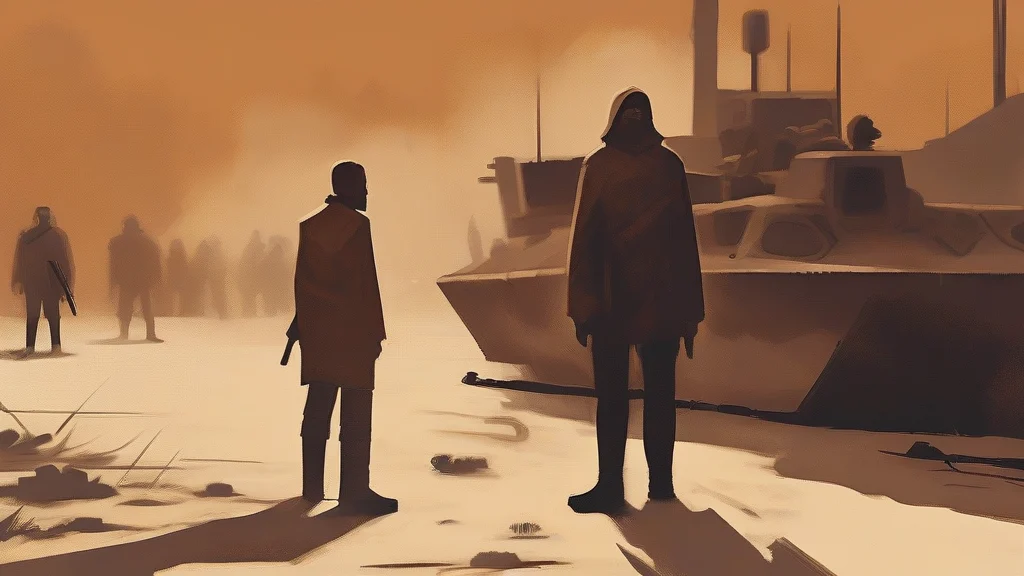
What does standoff mean?
A standoff is a situation in which opposing parties cannot or will not continue because of conflict, competition, or mutual caution. The term is especially common in political, diplomatic, military, and legal reporting, where it describes a stalemate, a tense confrontation, or a deadlock that prevents agreement or further action. For example, negotiations may reach a standoff when each side refuses to concede, while police may negotiate with an armed person holding hostages during a standoff. The word can also describe a literal separation between people, objects, or forces, particularly in a military context. Its implications depend on the circumstances: it may suggest prudent caution, persistent tension, or an unresolved problem. Because “standoff” emphasizes the mutual nature of the situation, it commonly implies that neither side has achieved its objective. The related adjective use appears in compounds such as “standoff agreement” and “standoff financing.”
nounA situation in which opposing parties are unwilling or unable to proceed because of conflict, competition, or mutual caution. It can also refer to a literal separation or distance maintained between people, groups, or forces.
- A deadlock or stalemate in which opposing parties cannot or will not proceed.
- A confrontation in which parties maintain a cautious distance and avoid direct action.
- A separation or distance between people, objects, or opposing forces.
"The negotiations collapsed into a standoff, with neither side willing to make concessions."
"The prime minister warned that the hostage crisis could deteriorate into an armed standoff."
"A wide standoff between the two species was maintained by the empty stretch of land between their territories."
Used when referring to separate conflicts, impasses, or confrontations.
"The border produced several tense standoffs before the patrol agreement took effect."
A standoff begins when two opponents keep their distance, but it is their refusal to move forward that turns separation into a standoff.
Reviewed by Deb Chak, Editor. AI-assisted content curated by RJS Tech Solutions LLP.
Where does standoff come from?
Standoff is an English compound formed from “stand” and “off,” both of which have Old English origins. The lexicalized noun developed from the phrase “stand off” and came to denote separation, mutual opposition, or an inability to advance. Its relatives include words such as “understand,” “withstand,” “standpoint,” and “handstand,” which share the Germanic verb root represented by “stand.”
Related word forms
How standoff is actually used
The word is neutral in its basic sense but often suggests conflict, tension, or an unresolved impasse. It is especially common in political, diplomatic, military, and legal contexts. As a modifier, it is often written as one word, as in “standoff agreement,” though “stand-off agreement” also occurs.