
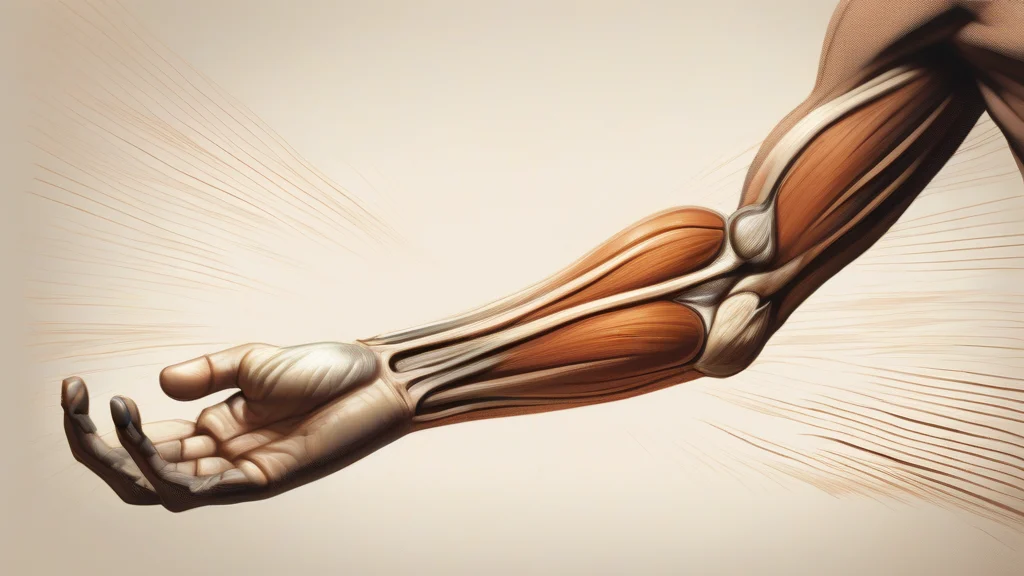
What does supination mean?
Supination is the anatomical term for turning the forearm so that the palm faces upward, or the position in which the palm is directed upward. It is the movement that makes it possible to hold a bowl, gesture with an open palm, or place the hand flat on a table with the fingers pointing upward. The opposite movement is pronation, which turns the palm downward. Supination can also describe the movement of the foot that turns the sole upward and inward. In medicine, physiotherapy, anatomy, and sports science, the term is more precise than ordinary descriptions such as “turning the hand over” or “rotating the wrist,” because it identifies a particular joint action rather than any general twisting movement.
nounSupination is the position or movement in which the palm of the hand faces upward or the forearm rotates so that the radius and ulna lie parallel. In anatomy, it also refers to the analogous upward rotation of the foot.
- The anatomical position in which the palm faces upward.
- The act of rotating the forearm so that the palm faces upward.
- The analogous outward rotation of the foot, turning the sole upward.
"The doctor asked her to perform supination, turning her palms upward as she held the forearm out."
"Supination of the forearm allows the hand to hold a bowl in the palm."
"The therapist noted limited supination after the patient's wrist injury."
Usually used in the plural when referring to separate instances of the movement.
"The therapist tested supinations in both forearms."
Supination is the motion that lets your palm face the ceiling; pronation is its opposite, turning the palm toward the floor.
Reviewed by Deb Chak, Editor. AI-assisted content curated by RJS Tech Solutions LLP.
Where does supination come from?
The word comes from Latin supinātiōn, a noun formed from supināre, “to bend backward” or “to turn onto the back.” These words are related to Latin supinus, meaning “lying on the back” or “inclined backward.” The English forms supine and supinate share this Latin root, while supinator names the muscle responsible for forearm supination.
Related word forms
How supination is actually used
In anatomy and physical therapy, the term is technical but widely understood in clinical contexts. In general anatomical description, it may refer to either the position or the movement involved.
Easily confused with supination
Supination turns the palm upward or the sole outward, whereas pronation turns the palm downward or the sole inward.
Supination is the movement or position itself, while supinate is the verb describing that movement.