
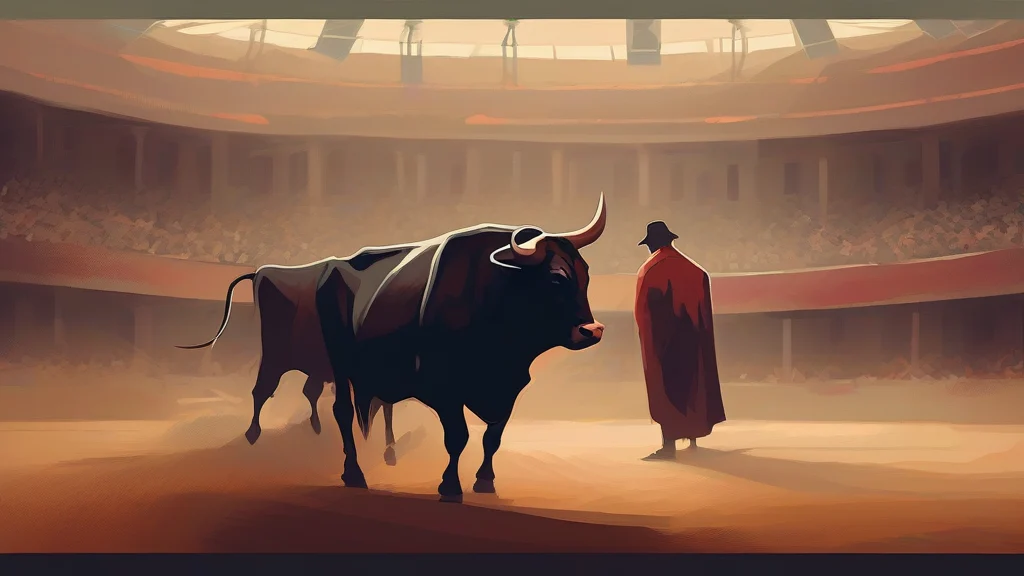
What does tauromachy mean?
Tauromachy is a formal, chiefly literary noun meaning a bullfight, particularly the ritualized contests staged in ancient Greece and Spain. Its deliberately learned tone distinguishes it from ordinary descriptions such as bullfight or bullfighting, and it is most common in historical, archaeological, and cultural discussions. In ancient Greece, a tauromachy might involve a bull being brought into a public arena, fought or baited, and ritually sacrificed. The Spanish tradition includes the familiar practices of the corrida, though modern participants and audiences more often use corrida or bullfighting. Tauromachy also carries an unavoidable association with animal suffering and danger to the bullfighter, so it should not be treated as a neutral synonym for sport. The term is useful when discussing bullfighting as ceremony, mythology, public spectacle, and violence involving both human courage and severe harm to the bull.
nounA bullfight, especially the ritualized form practiced in ancient Greece or Spain.
- A ritualized or traditional bullfight, particularly one associated with ancient Greece or Spain.
"The museum label identifies the scene as an ancient Greek tauromachy, with a bull confronting armed youths in an arena."
"Archaeologists interpreted the painting as a tauromachy in which several youths defend themselves from a charging bull."
"The festival's principal attraction was a Spanish tauromachy featuring the celebrated matador Rafael Gómez."
The standard plural is tauromachies, though the word is uncommon enough that the singular form is used far more often.
"The collection documents tauromachies held across the ancient Mediterranean."
The Greeks made it mythological and Spain made it theatrical, but in both traditions the bull faced a deadly outcome.
Reviewed by Deb Chak, Editor. AI-assisted content curated by RJS Tech Solutions LLP.
Where does tauromachy come from?
The English word derives from Greek ταυρομαχία (tauromakhía), formed from ταῦρος (tauros), meaning bull, and μάχη (máchē), meaning battle or fight. The Greek compound was Latinized as tauromachia before being adopted into English, with French tauromachie and Spanish tauromaquia among the related forms.
Related word forms
How tauromachy is actually used
Formal and chiefly literary. The term is especially common in historical, archaeological, and cultural discussions; for an ordinary modern bullfight, bullfight or corrida is usually more natural. It necessarily evokes animal suffering and danger to the bullfighter.
Easily confused with tauromachy
Tauromachia is the Latinized Greek form of the word, while tauromachy is the standard modern English form.