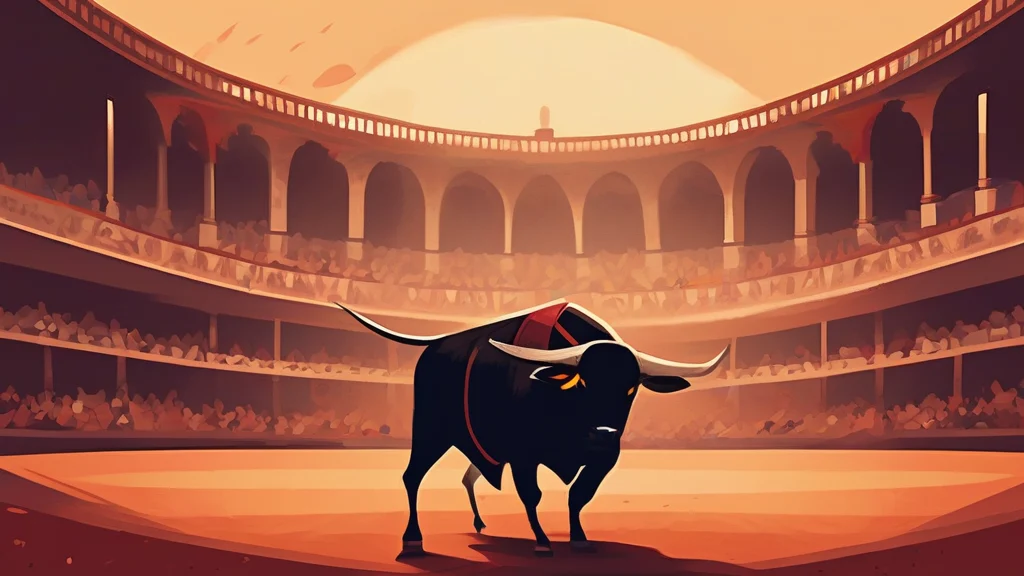
What does bullfighting mean?
Bullfighting is a noun referring to the traditional spectacle in which a trained performer, called a matador or torero, confronts and usually kills a bull in an arena before an audience. Most closely associated with Spain, it also has deep roots in Portugal, southern France, Mexico, Peru, Colombia, and other Latin American countries, where it is often described as a ritualized performance governed by strict rules of dress, sequence, and conduct. The word carries powerful connotations on both sides of a long-running debate: admirers frame it as an ancient art form and cultural heritage, frequently using terms like corrida or fiesta brava, while critics condemn it as cruelty toward animals, leading to bans and restrictions in some regions, such as Catalonia. Common collocations include 'bullfighting season,' 'bullfighting ring,' and 'go bullfighting.' The term is standard and neutral in register but rarely emotionally neutral in use, making it a useful word for discussing tradition, ethics, and cultural identity.
nounA traditional spectacle, especially in Spain and parts of Latin America, in which a matador and other performers fight and typically kill a bull in an arena according to a formal ritual.
- The traditional spectacle in which a matador ritually fights and kills a bull before spectators.
- More broadly, the practice or profession associated with such events (e.g. the world of bullfighting).
"Thousands of spectators filled the arena to watch the bullfighting festival in Pamplona."
"Bullfighting remains legal in much of Spain, though it has been banned in Catalonia."
"She spent a year writing about the culture and controversies of Mexican bullfighting."
Rarely pluralized; the word is normally uncountable when referring to the practice generally. A plural may occasionally appear when counting distinct events, but 'bullfights' is preferred in that case.
"The region hosted several major bullfights last season rather than separate bullfightings."
The word 'bullfighting' is a misnomer to purists: in the Spanish corrida there's no 'fight' at all — it's a choreographed ritual that ends with the bull's death, not a contest between equals.
Reviewed by Deb Chak, Editor. AI-assisted content curated by RJS Tech Solutions LLP.
Etymology of bullfighting
Bullfighting is a straightforward English compound of 'bull' — from Old English 'bulla', a Germanic word — and 'fighting', from Old English 'feohtan'. The practice itself entered Britain's awareness largely through Spanish culture in the early modern period, and the English compound reflects that borrowing of the activity rather than its language; Spanish uses 'corrida de toros' (literally 'running of the bulls'), and related Spanish-derived terms include 'matador', 'torero', and 'picador'. A learned Greek-rooted synonym, tauromachy (from 'tauros' meaning bull), exists but is rare and chiefly literary.
Related word forms
How bullfighting is actually used
Neutral in register but strongly connotative: supporters describe it as art or tradition ('fiesta brava'), while opponents view it as animal cruelty. It is often used in discussions of animal rights, heritage, and regional law.
Easily confused with bullfighting
Bullying means intimidating or mistreating a weaker person, while bullfighting is the ritual spectacle of fighting a bull.