
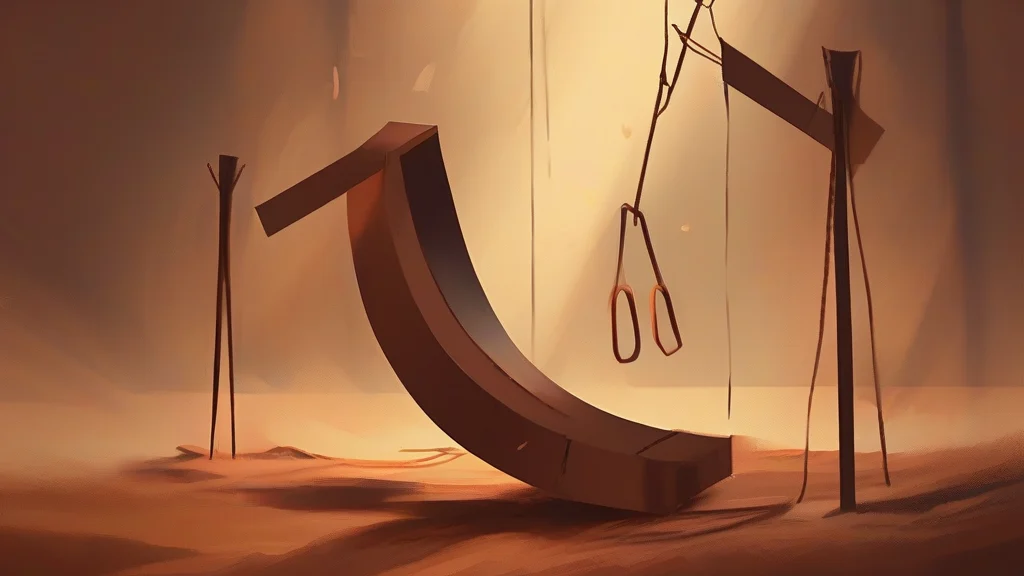
What does teeter mean?
Teeter is chiefly a verb describing unstable movement or a precariously uncertain situation. When used physically, it means to wobble, stagger, or balance unsteadily, often with the implication that a fall is imminent. Its figurative use is at least as common: a person, institution, economy, or government may teeter between two choices, teeter on the brink of failure, or teeter between success and disaster. The word is especially effective when something remains unstable but has not yet reached a final outcome. It therefore conveys both motion and suspense, making it useful for describing last-minute decisions, precarious political situations, financial problems, or physical acts of balance. Although teeter can also be used as a rare noun for an unsteady or balancing movement, it is remembered primarily as a vivid verb. Its imagery makes it particularly memorable: the subject is not yet down, but is visibly and dangerously close to losing control.
To move, stand, or balance unsteadily; to waver; or to remain precariously close to failure or collapse.
"The old ladder teetered as he climbed toward the roof."
Figurative uses commonly suggest that an outcome or decision remains uncertain.
An unsteady movement or balancing motion.
"With a final teeter, the toy regained its balance."
The noun is rare and is chiefly used for an instance of unsteady movement.
The rare countable noun is pluralized as teeters, although singular usage is much more usual.
"The series of teeters knocked the toy off the table."
Teeter captures the moment when nothing has fallen yet—but everything seems poised to fall.
Reviewed by Deb Chak, Editor. AI-assisted content curated by RJS Tech Solutions LLP.
Where does teeter come from?
The word appeared in Middle English as titeren, with meanings connected with shaking, instability, and toppling. It is generally understood to have been borrowed from a Middle Dutch form meaning to shake or move unsteadily, although its precise pre-English ancestry is uncertain. Over time, the physical sense developed into the figurative sense of wavering between outcomes or approaching failure.
Related word forms
How teeter is actually used
The verb is the dominant form. Its literal use suggests an unstable physical balance, while its figurative use conveys danger, indecision, or a situation that could develop in several very different ways. The noun is comparatively rare.
Easily confused with teeter
To teeter is to wobble or waver, whereas to titter usually means to laugh in a restrained, nervous, or high-pitched way.