
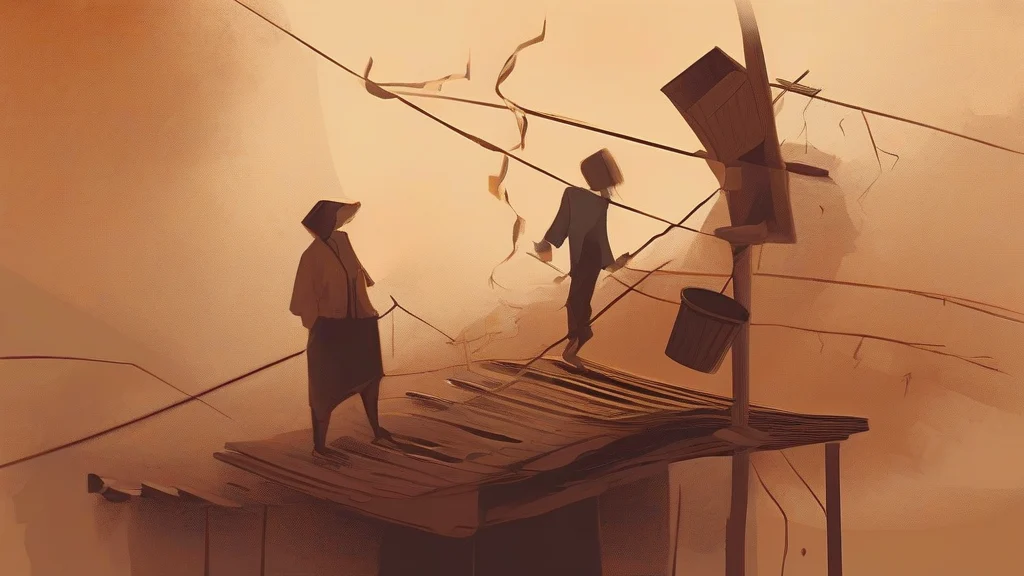
What does teetered mean?
Teetered is the past tense and past participle of teeter, a verb meaning to move or stand unsteadily, as if about to fall. Its figurative use describes a person, organization, decision, or situation that is wavering or remains dangerously close to an undesirable outcome. For example, a government may teeter between collapse and recovery, while a negotiator may teeter between two positions. The word is especially effective when balance is central to its meaning: it evokes both physical instability and the precariousness of being suspended between alternatives. Unlike a general expression of uncertainty, teetered often implies that the situation could tip decisively in either direction. It is common in journalism, political commentary, narrative writing, and formal analysis, and it can describe literal loss of balance as readily as financial ruin, indecision, or political collapse.
verb (past tense and past participle)To move or stand unsteadily, as if about to fall; figuratively, to hesitate or waver between alternatives or outcomes.
- To move or stand unsteadily, as if about to fall.
- To hesitate, waver, or remain in a precarious or uncertain state.
"The company teetered on the edge of bankruptcy before a last-minute investor rescued it."
"She teetered on the narrow ledge, carefully adjusting her footing."
"The inquiry teetered between two competing explanations throughout the hearing."
To teeter is to stand between safety and disaster, making every second feel like a choice.
Reviewed by Deb Chak, Editor. AI-assisted content curated by RJS Tech Solutions LLP.
Where does teetered come from?
English evidence for the verb teeter dates from the early nineteenth century, when it was used for moving or standing unsteadily. It is often linked to an earlier English word used for wobbling or tilting, although the deeper origin is uncertain. The verb is also associated with teeter-totter, an older term for a seesaw-like balancing apparatus, and with the balancing game now commonly called teeterboard.
Related word forms
How teetered is actually used
The word is neutral in register and is especially common in figurative descriptions of precarious finances, decisions, outcomes, or prospects. It conveys instability more vividly than simply being uncertain, often suggesting that a situation could tip either way.
Easily confused with teetered
Teetered describes unsteady movement or wavering, whereas tittered describes laughing in a restrained or nervous way.
Teetered can describe any unstable movement or a figurative state of uncertainty, while tottered more specifically suggests walking unsteadily or appearing close to collapse.